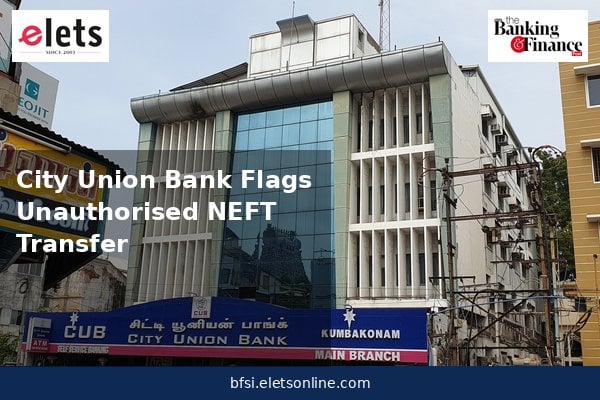


City Union Bank Ltd (CUB), the Kumbakonam-headquartered private sector lender, has disclosed an unauthorised NEFT transaction in one customer account on 16 November 2026. The bank told the stock exchanges on 18 November 2026 that it shut down the NEFT and RTGS gateway linked to that account as soon as it became aware of the incident, and that it is working with leading experts on the investigation.
The bank said the incident has no material impact on its core business operations, financial performance or business continuity, and that its core functions continue to run normally. The disclosure was made under Regulation 30 of the SEBI Listing Obligations and Disclosure Requirements (LODR) Regulations, 2015, in a filing to NSE and BSE signed by Company Secretary and Compliance Officer Venkataramanan S.

What happened at City Union Bank?
According to the filing, one unauthorised transfer went out through the National Electronic Funds Transfer (NEFT) system from a single customer account. CUB responded by closing the NEFT and RTGS payment gateway for that customer’s account, not across the bank. The matter is being analysed to find the root cause, and corrective measures are under way.

The bank has not disclosed the amount involved, the identity of the customer, whether the funds have been recovered, or whether the incident involved compromised credentials, a technical vulnerability or another form of unauthorised access. CUB said it continues to monitor the situation and will act in line with statutory and regulatory requirements.
Key facts from the disclosure
- Date of incident: 16 November 2026; disclosed to exchanges on 18 November 2026.
- Scope: one customer account; the NEFT and RTGS gateway for that account was shut down.
- Response: internal investigation with external experts; root-cause analysis and corrective measures in progress.
- Business impact: no material impact on core operations, financial performance or business continuity, the bank said.
Why the City Union Bank NEFT incident matters
The disclosure comes as the Reserve Bank of India (RBI) steps up its focus on cyber risk in payment channels. Earlier this month, the regulator mandated API safeguards for bank-NBFC fund transfers after fraudsters manipulated loan-disbursement instructions, and it issued cyber resilience rules for non-bank payment system operators that require incidents to be reported within six hours.

Lenders have been hit through payment rails before. Microfinance lender Spandana Sphoorty reported a ₹7.8 crore cyber fraud in which funds were sent to 82 accounts, and RBI data showed digital payment frauds rose to 3.58 lakh cases in September. For banks, the City Union Bank case is another reminder that monitoring of high-value transfer gateways, beneficiary checks and fast isolation of affected accounts are now core controls rather than back-office tasks.
The incident follows a strong quarter for the lender. CUB recently reported a 27% rise in Q2 FY27 profit to ₹416 crore.
What customers should know
NEFT and Real Time Gross Settlement (RTGS) are payment systems operated by the RBI and run round the clock. Under the RBI’s existing customer protection framework for unauthorised electronic banking transactions, customers can have zero liability when a loss is caused by the bank’s negligence, or by a third-party breach reported within three working days of receiving the transaction alert. Customers who notice a suspicious debit should report it to their bank immediately through its official channels.
Key takeaways
- City Union Bank detected an unauthorised NEFT transaction in one customer account on 16 November 2026.
- It shut the NEFT and RTGS gateway for that account and is investigating with external experts.
- The bank says there is no material impact on its operations, financials or business continuity.
- The amount involved and the cause have not been disclosed.