

If you have been thinking about going solar in Gurugram or Faridabad, one thing probably stopped you early: the upfront costs. To apply for rooftop solar under PM Surya Ghar Muft Bijli Yojana through DHBVN, you had to pay two fees at the time of application. Before anyone came to your house. Before your panels went up. Before your system generated a single unit of power. For many households, that cash outlay on top of the installation cost was enough to shelve the plan indefinitely.
DHBVN’s circular D-10/2026, issued on August 10, 2026, removes this entirely. Both charges now arrive only in your first electricity bill after your solar system is commissioned and running. Managing Director Vikram Singh said the decision was made to remove the cash barrier and help more households in south Haryana actually follow through on PM Surya Ghar. That first bill after commissioning will look a little different from your regular ones it combines your electricity charges, your net metering adjustment, and the two deferred fees all together. When it lands, Bajaj Pay, the Bharat Connect payments platform on Bajaj Finance, pulls your live outstanding amount directly from DHBVN so you see exactly what you owe before you confirm a single rupee, through UPI, cards, or net banking.

The two charges that were blocking applications
The first is the net meter charge. When you go solar, DHBVN swaps your regular electricity meter for a two-way meter that records both what you draw from the grid and what your solar panels send back. Installing that meter costs money. DHBVN used to collect this fee when you applied, before any work had started. Under circular D-10/2026, it now shows up in your first DHBVN bill payment cycle after commissioning instead.

The second is the load enhancement charge. This only comes up if your planned solar system is bigger than your current connection allows. A household with a 3 kW connection wanting a 5 kW solar system needs to upgrade the connection first and that upgrade carried an upfront cost. That too is now deferred to the first post-commissioning bill.
Neither of these is paid at application anymore. The amounts have not changed. Only when you pay them has.

How net metering works once your system is live
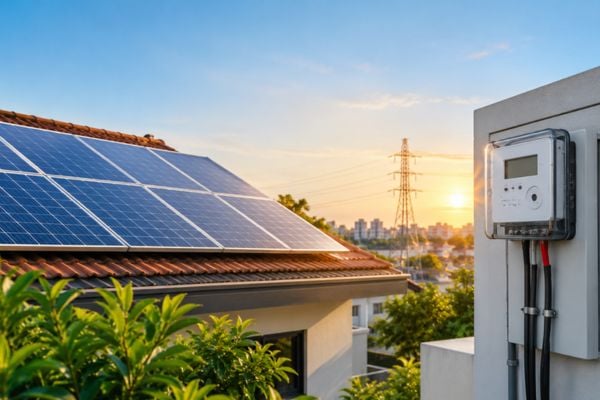
Once the two-way meter is active, your monthly bill is calculated on what you actually needed from the grid that month, not your total consumption. Here is a simple example. Your home uses 300 units in a month. Your 3 kW rooftop system generates 380 units that same month. You drew 300 units from the grid but sent 380 units back. Your net grid consumption that month is zero. Your energy charge is zero.
The extra 80 units you sent to the grid are not lost. DHBVN banks them as a credit in your account across the year. Each March, DHBVN settles all your surplus units at approximately Rs. 3.00 to Rs. 3.50 per unit under HERC Regulation 54 of 2021. Over a year, that adds up meaningfully on top of your monthly bill savings.
Your fixed charge still applies every month it is tied to your connection size, not your consumption. But the energy charge, usually the bigger part of your bill, can fall to near zero in good months.
Reading your first post-commissioning bill
That first bill after your solar system goes live is the one to look at closely. It will include your normal electricity charges for the period, the net metering adjustment from your solar generation, and the two deferred fees arriving together for the first time.
Keep a copy. You will likely need it when claiming your PM Surya Ghar subsidy or tracking net metering credits across the year. Download your DHBVN bill receipt on Bajaj Finance any time using your Consumer Account Number it comes through as a digital copy you can save, share, or submit for documentation.
What the PM Surya Ghar subsidy covers
The central government PM Surya Ghar Muft Bijli Yojana subsidy gives you up to Rs. 78,000 for a 3 kW rooftop solar installation. This is the full benefit available to DHBVN consumers right now; Haryana stopped its own state-level capital subsidy in April 2026, so there is no state top-up. But Rs. 78,000 off the total cost is still significant.
A 3 kW installation in Haryana typically costs Rs. 2.20 to Rs. 2.50 lakh. After the subsidy, your net cost is approximately Rs. 1.42 to Rs. 1.72 lakh. Most households save Rs. 1,500 to Rs. 2,000 per month on their electricity bills after going solar. At that rate, the system pays for itself in four to five years.
DHBVN allows you to install solar up to the size of your current connection with no extra steps. A 5 kW connection supports a 5 kW system. If you want something bigger, you need to upgrade your connection first and under D-10/2026, that upgrade fee now comes in your first bill after your system is live, not before you apply.
Steps to pay your DHBVN bill on Bajaj Finance
- Open the Bajaj Finance app or visit bajajfinserv.in and log in
- Go to Bills and Recharges and select Electricity Bill Payment
- Select DHBVN from the list of providers
- Enter your Consumer Account Number and fetch your current bill
- Check the exact amount shown before confirming
- Pay via UPI, debit card, credit card, or net banking for an instant Bharat Connect receipt
Two fees were quietly stopping rooftop solar applications across Gurugram and Faridabad before they got started. Both have now moved to your first electricity bill after your panels are switched on and generating power. The Rs. 78,000 PM Surya Ghar subsidy is still available. The application is simpler. If going solar has been on your list, the most common reason to put it off no longer applies.