



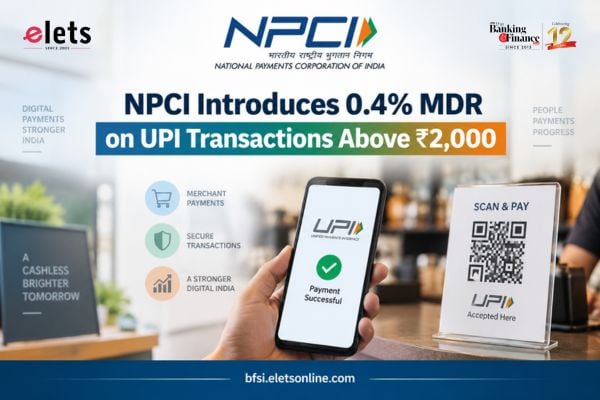


The National Payments Corporation of India (NPCI) has introduced a Merchant Discount Rate (MDR) of 0.4% on Person-to-Merchant (P2M) UPI transactions above ₹2,000, effective October 15, 2026.
Under the revised framework, high-value purchases of ₹75,000 and above will attract a capped MDR of ₹300 per transaction. UPI transactions of up to ₹2,000 and all Person-to-Person (P2P) transactions will continue to remain free.

For select merchant categories, including railways, telecom, insurance and fuel, a flat MDR of ₹5 per transaction will apply to payments above ₹2,000. Capital market transactions, including payments for mutual funds, securities and stockbrokers, will attract an MDR of 0.02%, capped at ₹300.
The framework was finalised by the UPI and Services Steering Committee and introduces a revenue-sharing mechanism for the 40-basis-point MDR. Issuer banks will receive 40%, merchant acquirers 30%, UPI apps 20% and their bank partners 10%.
Small merchants receiving up to ₹1 lakh per month through UPI QR directly into their accounts will continue to be exempt from MDR. NPCI said transactions up to ₹2,000 account for more than 95% of total UPI P2M transaction volume, meaning the majority of everyday transactions will remain unaffected.

The move marks the end of the zero-MDR regime for UPI merchant transactions introduced in January 2020. NPCI said operating UPI—including payment infrastructure, server bandwidth, fraud prevention and technical support—costs around ₹20,000 crore annually, and argued that a threshold-based commercial model would provide more reliable funding for continued technology investments.
Also Read: IAS Saurabh Kumar Appointed Govt Nominee Director of Bank of Maharashtra
NPCI has also announced a dedicated fund for digital payment infrastructure in Tier 3-6 centres, including the Northeast, Jammu & Kashmir and Ladakh, while supporting merchant onboarding and UPI adoption in Tier 1 and 2 centres under schemes such as PM SVANidhi and PM Vishwakarma.
Payment industry expert Praveen Dhabhai said the revised framework seeks to balance infrastructure investment with grassroots adoption by keeping small merchants and the majority of everyday UPI transactions zero-rated.