




A few years ago, a young professional received his first salary. He did what many of us do. He bought a new phone, had dinners with friends, did online shopping, and took a vacation loan with an EMI that seemed harmless because “it is just ₹3,000 a month.” As years went by, his income kept increasing every year, but what he saw is that by the age of thirty, he had no savings, mounting debt, and anxiety around his financials which never left his mind.
Now think about someone else earning nearly the same amount. She started small. Set aside a fixed sum every month. Understood insurance before she bought it. Picked up the basics of investing. Learned slowly to distinguish between what she wanted and what she needed. Ten years later, the gap between the two wasn’t about income it was about financial literacy.

And that, perhaps, is the biggest misconception of our times: earning money and understanding money are not the same thing.
We live in an age where financial decisions show up every single day, whether we are ready for them or not. Credit cards promise rewards. Apps approve loans in minutes. Social media influencers push stocks and crypto trends like they are selling chai. Buying has never been easier. Understanding the consequences? That is a different story.

Warren Buffett, very correctly, said, “Risk comes from not knowing what you are doing.” Here, Buffett was not just talking about the stock market. That line applies to every financial choice any of us will ever make.

In India, people see financial literacy as something that is only meant for bankers, economists, or people in suits. It starts with the simplest of questions:

- Should I save or invest right now?
- Do I really need insurance?
- How much debt is too much?
- Are twenties the right time to start thinking about my retirement finances?
- How affordable are EMIs?
India’s economy keeps posting some of the fastest growth rates in the world, but our relationship with money hasn’t quite kept pace. Go back a decade or two, and financial planning for most families meant a savings account, maybe some gold tucked away for a rainy day. That picture looks very different now, with digital payments, investment apps, and a whole ecosystem of financial products reshaping how people handle their money.
A lot of that shift comes down to technology. UPI, investment platforms, insurance apps have put financial services in everyone’s pocket in a way that simply wasn’t possible before. People can check, learn, and act on financial decisions almost instantly. Add to that the explosion of finance content on YouTube, podcasts, and other interactive formats, and ideas that once felt intimidating are suddenly a lot more approachable. Still, easier access cuts both ways. It’s also opened the door to more misinformation and more impulsive, ill-informed decisions, which is exactly why financial literacy matters now more than ever. It’s not enough to have access to these tools; people need to know how to use them well.
And financial literacy isn’t just a personal-finance issue. When people understand how money works, entire communities benefit. Families are less likely to become prey to predatory lenders or scams, plan better, and avoid unnecessary debt traps. The numbers tell us the stakes are pretty clear. The RBI’s Annual Report shows that the amount involved in banking-sector fraud has jumped 46%, from ₹32,803 crore to ₹48,021 crore in FY2026, even as the actual number of cases fell sharply, from 23,722 to just 10,114. Fewer incidents, but far bigger losses. That gap alone shows why financial literacy isn’t some abstract goal. It’s protection against real, sometimes life-altering damage.
That awareness has to be built, and no one group can do that by itself. It takes families, communities and government working together.
On that last front, the government has actually made some solid moves. The Pradhan Mantri Jan Dhan Yojana brought in crores of hitherto unbanked people into the formal banking system for the first time. Basic life and accident cover has been made available to ordinary households at next to nothing through schemes such as the Pradhan Mantri Jeevan Jyoti Bima Yojana and the Pradhan Mantri Suraksha Bima Yojana. And the Atal Pension Yojana has been quietly helping workers in the informal sector in creating some kind of financial cushion for their later years.
These are not just government schemes. They reflect a larger vision of an India where every citizen not just the privileged few has a real shot at financial security and long-term planning.
But government schemes alone can’t do this. Financial literacy must start at home. The homemaker, already doing a pretty amazing thing each month, figuring out the monthly cost of running the household. Juggling needs, priorities and making decisions with limited resources, often without anyone even noticing the skill involved. When they become more financially savvy, the whole family benefits. Kids who get the fundamentals down early-saving, budgeting, understanding what debt really means, tend to have those habits for a long time into adulthood.
We teach children mathematics and language as a matter of course. Money should get the same treatment, not as some specialized professional skill, but as something every person simply needs to know to get through life. Giving someone a bank account without any financial education is kind of like giving someone the keys to a car without ever teaching them how to drive. The account is only as good as the person’s ability to use it well, just like the car.
With India moving towards becoming a developed nation, financial literacy cannot be an option anymore. It’s not just about building wealth; it’s about building confidence — the kind that allows people to make informed decisions, stand on their own two feet, and not lie awake at night worrying about money they don’t have.
After all, at the end of the day, financial freedom isn’t about how much you make.
Note: The views expressed in this article are solely the author’s own and do not necessarily reflect the views of the organization.
Source: Reserve Bank of India (RBI) Annual Report 2025-26
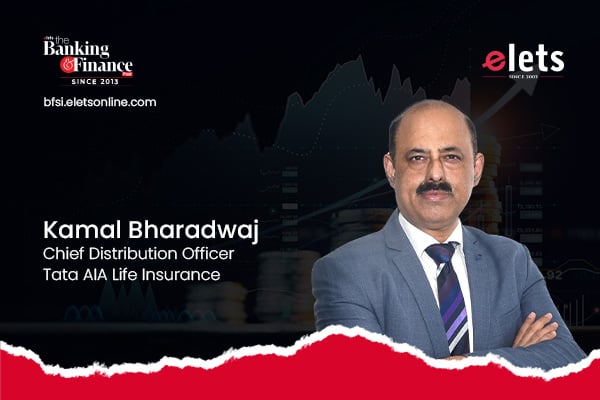
Views expressed by: Kamal Bhardwaj, Chief Distribution Officer, Tata AIA Life Insurance