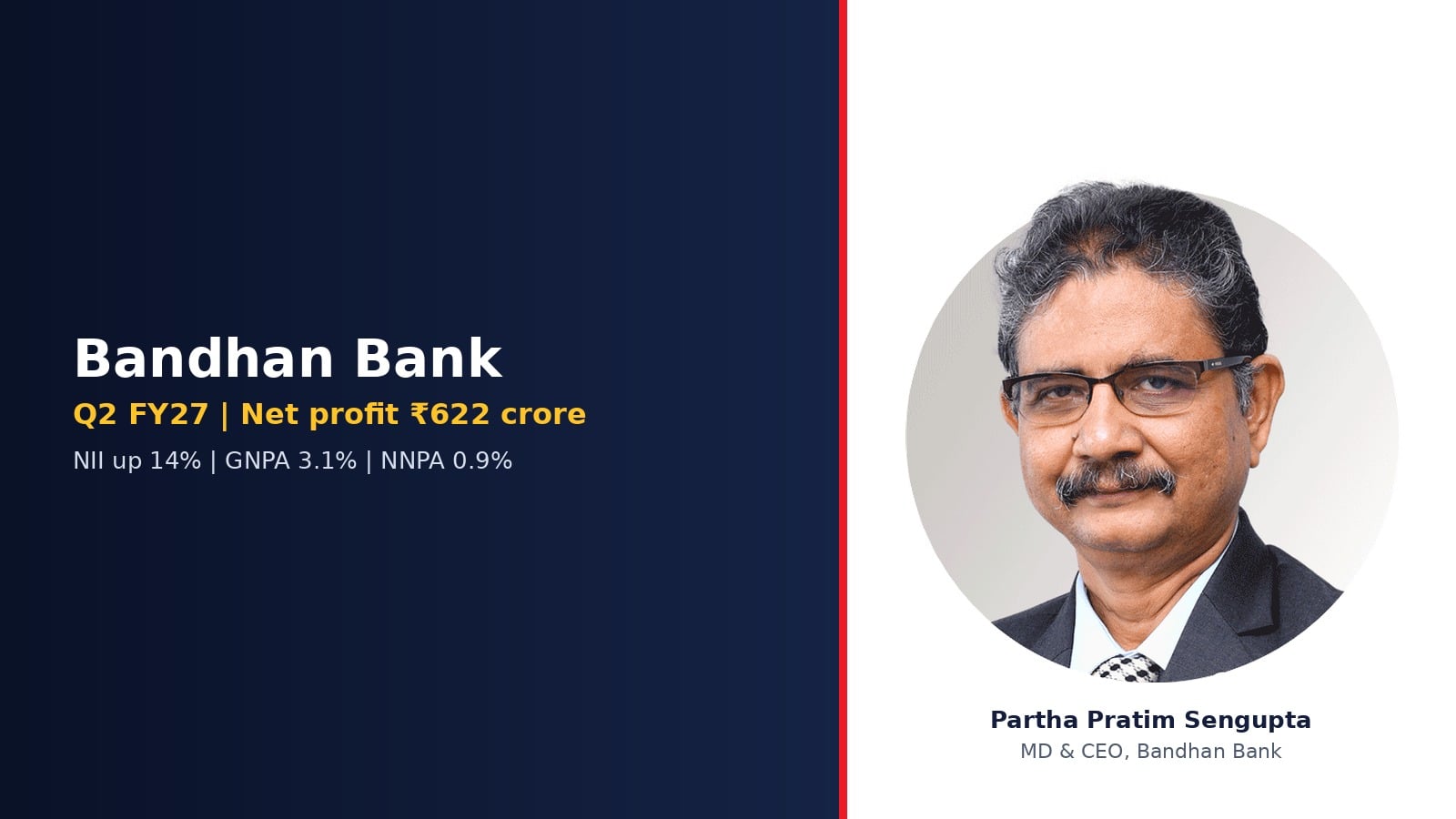


Bandhan Bank reported a net profit of ₹622 crore for the second quarter of FY27 (July–September 2026), more than five times the ₹112 crore it earned in the same quarter last year, as sharply lower provisions and steady core income growth lifted earnings. The Kolkata-headquartered lender’s board approved the results at a meeting in Kolkata on 28 October 2026.
Net interest income (NII) rose 14% year-on-year to ₹2,960 crore from ₹2,589 crore, while net total income grew 17% to ₹3,665 crore. Operating profit increased to ₹1,556 crore from ₹1,310 crore a year earlier.

Provisions drive the earnings jump
The biggest swing came from credit costs. Provisions and contingencies fell to ₹718 crore in the quarter from ₹1,153 crore in Q2 FY26, though they edged up from ₹683 crore in the June quarter. The bank said credit cost was broadly stable sequentially at 1.8%, compared with 3.4% a year ago.

For the first half of FY27, profit after tax stood at ₹1,123 crore against ₹484 crore in H1 FY26. Net interest margin for the half year was 6.2%, with annualised return on assets of 1.1% and return on equity of 8.5%.
Asset quality improves year-on-year
Gross non-performing assets (GNPA) stood at 3.1% at the end of September, down from 5% a year earlier, and net NPA improved to 0.9% from 1.4%. Both ratios were broadly flat compared with the June quarter. Provision coverage including technical write-offs was 86.7%, and collection efficiency in the bank’s Emerging Entrepreneurs Business (EEB), its microfinance-heritage segment, was 99.3%. The bank also reported sequential improvement across its SMA-0, SMA-1 and SMA-2 buckets in the EEB portfolio.

Shift to secured lending continues
Gross advances grew 13% year-on-year to ₹1.58 lakh crore. Secured loans rose 18% and now make up over 57% of the book, compared with 55% a year ago. Retail loans other than housing grew 42% and wholesale banking 32%, while housing grew 4% and the EEB book 2%.
Total deposits rose 9% to ₹1.73 lakh crore. CASA deposits stood at ₹46,132 crore, taking the CASA ratio to about 27%, while CASA plus retail term deposits made up 73% of total deposits. Capital adequacy stood at 18.3%, well above the regulatory requirement of 11.5%.
Credit cards join the universal banking push
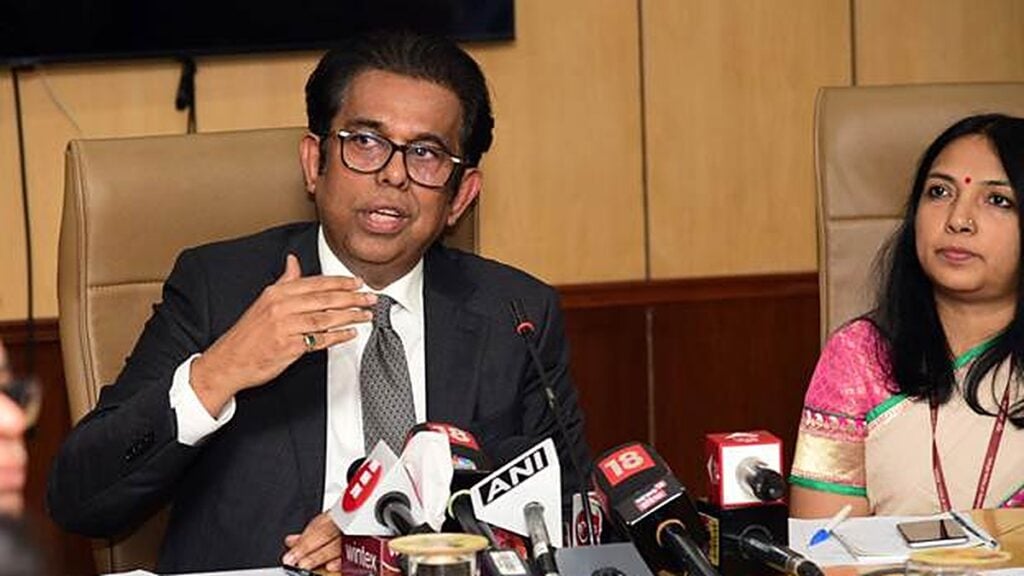
On the post-results earnings call, Managing Director and CEO Partha Pratim Sengupta said the bank launched its credit card business during the quarter with four variants, Spark, Ignite, Flare and Lumina, aimed at segments ranging from Gen Z and emerging affluent customers upwards, calling it another milestone in the bank’s universal banking journey.
“Our performance in Q2 FY26-27 reflects our focus on maintaining healthy business growth, accelerating deposit mobilisation, improving the composition of our loan portfolio, protecting asset quality and steadily strengthening profitability,” Sengupta said in the bank’s results statement. “We will continue to focus on strengthening our retail franchise, deepening customer relationships, and delivering long-term value to all stakeholders.”
Bandhan Bank operates 2,001 branches and 4,414 banking units across 35 states and union territories, serving around 3.2 crore customers.
Why it matters
Bandhan Bank has spent the past year rebalancing away from its microfinance roots toward secured retail and wholesale lending. A five-fold jump in profit, lower credit costs and a falling NPA ratio suggest that clean-up is paying off, though a sub-30% CASA ratio and provisions that ticked up quarter-on-quarter will keep investors watching funding costs and asset quality as RBI’s tighter liquidity stance pushes deposit rates higher.