


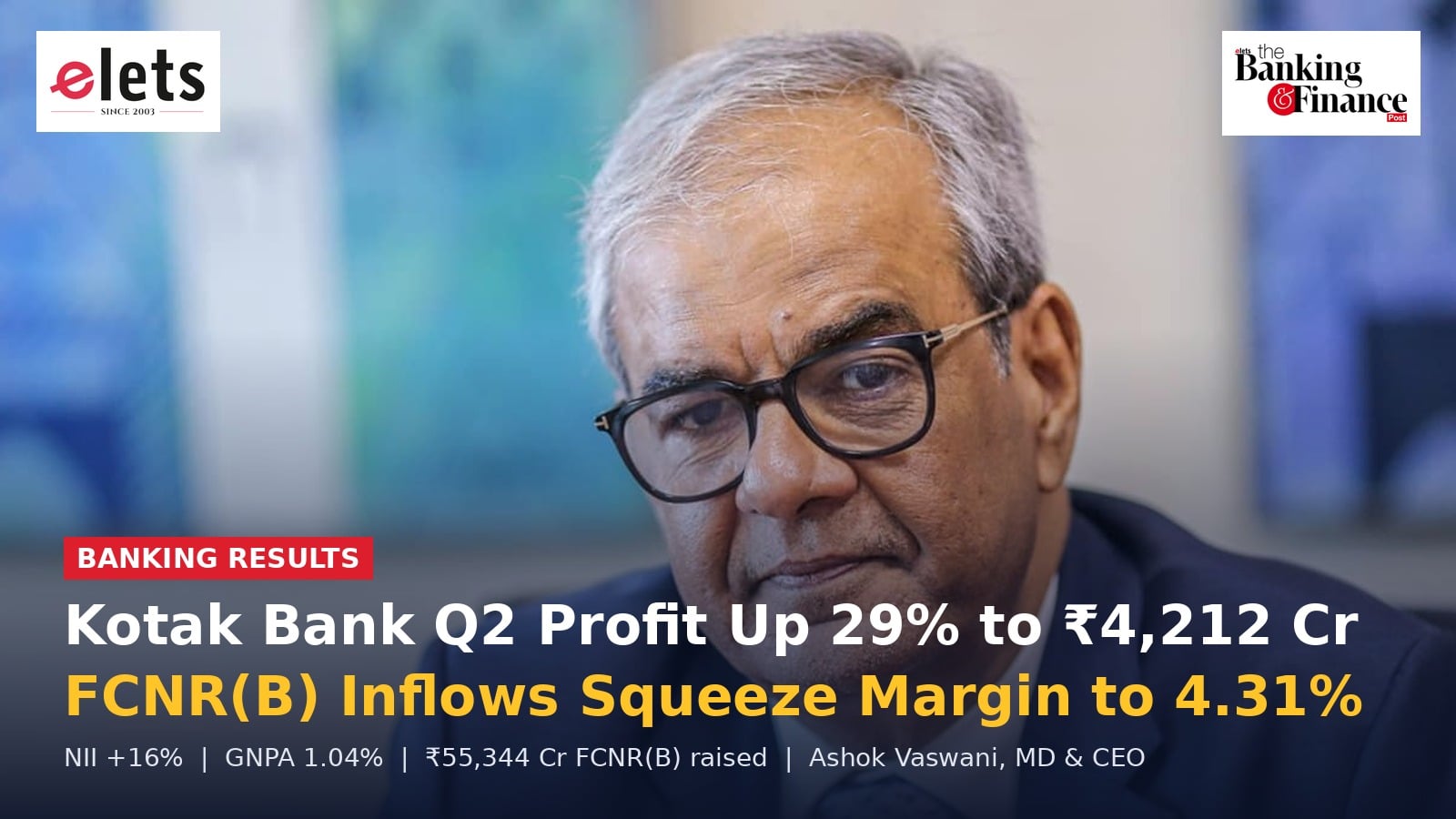


Kotak Mahindra Bank has closed the second quarter of FY27 with a sharp rise in earnings, cleaner asset quality and a balance sheet swollen by foreign currency deposits. The flip side is a thinner lending margin, which the bank says should start to recover as it puts that liquidity to work. The results, announced on Saturday, 24 October 2026, are also the last that MD and CEO Ashok Vaswani will present before he hands over to Anup Saha on 1 January 2027.
The numbers
Standalone net profit for the July-September quarter rose about 29 per cent year-on-year to ₹4,212 crore, from ₹3,253 crore a year earlier. Net interest income grew nearly 16 per cent to ₹8,459 crore, and operating profit climbed around 21 per cent to ₹6,382 crore, according to the bank’s exchange filing. At the group level, consolidated profit after tax rose 26 per cent to ₹5,645 crore, with subsidiaries contributing roughly a quarter of the total.

Asset quality kept improving. Gross NPAs fell to 1.04 per cent from 1.18 per cent in the June quarter and 1.39 per cent a year ago, while net NPAs eased to 0.24 per cent. Management said credit cost dropped to 35 basis points from 46 basis points in the previous quarter, which it credited to tighter underwriting and stronger collections.

The FCNR(B) effect
The biggest factor this quarter was the RBI’s special swap window for Foreign Currency Non-Resident (Bank) deposits. Kotak raised ₹55,344 crore through FCNR(B) deposits, which management put at close to 10 per cent of its June deposit base. Vaswani described the programme as a “one-off opportunity”.
The inflow lifted reported growth. Net advances rose 25 per cent to about ₹5.77 lakh crore. That figure includes loans made against FCNR(B) deposits and a loan book of roughly ₹9,600 crore moved over from subsidiary Kotak Mahindra Investments. Without those two items, core advances grew 19 per cent. The same inflow also distorted the funding mix. The CASA ratio fell to 38.2 per cent from 42.3 per cent a year ago, but it was 41.8 per cent excluding FCNR(B) money.

Margins took the hit. Net interest margin narrowed to 4.31 per cent from 4.53 per cent in the June quarter and 4.54 per cent a year earlier. The bank said most of the fall came from parking FCNR(B) liquidity, and that its core margin was broadly flat on the previous quarter. So far, part of the money has gone into buying the subsidiary’s loan book, repaying costlier borrowings and running down high-cost deposits. The rest is still to be lent out.
“The margins will improve going forward in the next two quarters,” Group CFO Devang Gheewalla told reporters. He said NIMs should pick up as the funds move into customer loans and as repo-linked loans reprice. According to Gheewalla, about 60 per cent of the bank’s advances are linked to the repo rate.
A handover with continuity
Saha joined Kotak from Bajaj Finance in January 2026 and currently oversees retail banking, marketing and data analytics. The RBI approved him earlier this month for a three-year term as CEO. He told reporters the bank would stay focused on affluent and private banking, its digital-led Kotak 811 franchise, payments and SME banking. He also said he expects to spend close to 30 per cent of his time on technology. Vaswani added that Kotak could look at an Apple Pay tie-up over the next couple of quarters if customers want it.
Management said it was keeping an eye on rural lending after a weak monsoon, although it has not yet seen signs of stress.
Why it matters
Kotak’s quarter follows a pattern seen across Indian private lenders this season. Profits are strong and credit costs are falling, but FCNR(B) inflows are squeezing reported margins and CASA ratios. The questions for the second half of FY27 are how fast this liquidity turns into good-quality loans and whether margins recover as promised. For Kotak, the answers will also be the first test of a new CEO.