







Fintech
At a recent Symposium on Financial Inclusion, I was asked to participate in the closing debate. It was a great honour. However, I was asked to support the proposition that “Disruptive innovations in the financial sector can no longer respond to the daily challenges of poor people”. Ouch! For all my critiques of digital financial services and digital credit, arguing this side of the debate is a real challenge. Especially, when the potential for innovation and fintech to revolutionise our ability to deliver financial inclusion is so very clear.
Fintech
We have been working closely on a variety of initiatives that support fintechs and incubation labs. We are seeing a large number of extraordinary developments, tools, and solutions that can have a major beneficial impact on the lives of the poor. So arguing that fintech is unable and unlikely to respond to the needs of the poor was a tough ask.

I love fintech. I use fintech every day. I am a fintech fan but I am privileged and middle class – and so both educated and connected.
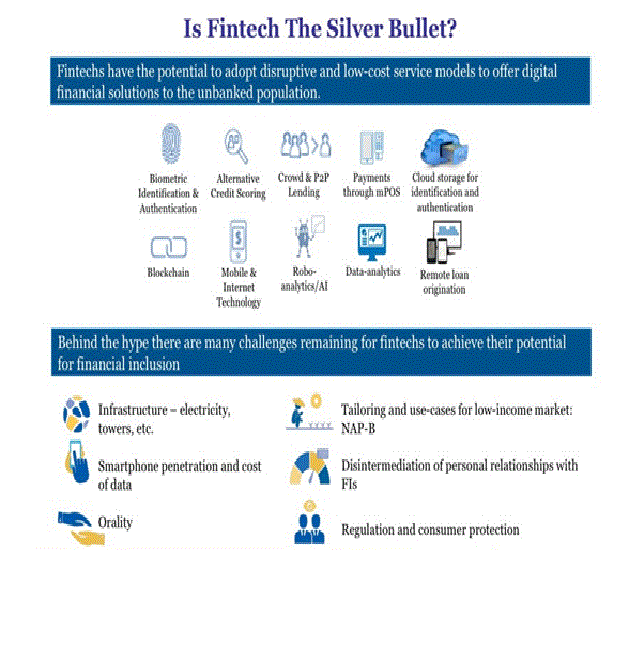
However, if we visit a typical rural village in a developing country, we would see that the situation is very different. Fintech, in its current form, may be largely irrelevant. Why so?
- In most rural villages there is inadequate infrastructure to support fintech. In these markets, fintech faces some basic challenges. This is leaving aside the challenges concerning the business-case and liquidity management for rural agents, which remain very real and persistent problems. In many villages, there is limited or no electricity, which makes powering phones or towers difficult. Many villages have no signal to support mobile telephony. In places that do have a signal, it is typically 2G and thus does not support most fintech services, which require 3G or above to function properly.
- Among poor households, there are few smartphones, and even the feature phones are owned by the men. This leaves women with limited or no access. A recent report highlighted that low-end smartphones have very limited RAM, which prohibits running many fintech apps. In addition, they also typically have hopelessly short battery life, screens that shatter easily, and a persistent problem with ‘fat finger error’that makes them almost unusable. These are the very devices that are expected to lead the charge of achieving mass smartphone penetration amongst the poor. Furthermore, the cost of data needed to make fintech transactions is usually prohibitively expensive. Indeed, in our fieldwork, we have seen some men in Africa proudly carrying prestigious smartphones but using them only to make or receive calls and SMSs.
- Furthermore, most villagers are ‘Oral’. They – along with another 1 billion-plus people across the planet – cannot read, write, or understand the long number strings necessary to transact on mobile phones. This has profound implications for their ability to use digital financial services. Indeed, asking them to move away from counting cash to digital interfaces will remove a key learning opportunity and strand them in a literate environment that they do not comprehend.
According to the World’s Women Report 2015, there are 781 million illiterate people on the planet. The underlying assumption that those that pass Standard V are literate and numerate is fundamentally flawed. These estimates, therefore, significantly understate the size of the problem – perhaps by as much as 100%. In India, for example, “Half of all children in Std V have not yet learned basic skills that they should have learned by Std II.” (Pratham, ASER 2014). - Fintech is irrelevant for most villagers because providers have made little efforts to tailor interfaces or use-casesfor the low-income market. The vast majority of fintech providers develop solutions for the affluent and middle classes. This makes logical sense – these segments have the money (and connectivity) to use the solutions. Furthermore, fintech developers typically come from this background. They, therefore, understand the challenges this segment faces and thus the opportunities it provides. In contrast, when and if fintech developers focus on the low-income segments, they tend to create solutions and then look for problems to solve in preference to understanding the needs, aspirations, perceptions and behaviour of the poor first.
- Furthermore, villagers value personal relationships– particularly when it comes to money. The idea of trusting technology that they do not understand for anything except very basic payments is out of the question. The idea of using a fintech solution on a mobile phone is alien and often even intimidating. This is particularly when the majority of systems they have seen or heard about remain unreliable and offer limited customer support and recourse.
- Finally, it is quite clear that till date, the regulatory environment and consumer protection provisions remain too weak to secure the poor. Many have already lost money in basic money transfer transactions. Millions are negatively listed on credit bureauxand in the databases of large banks because of digital credit.
Perhaps it is time to take a step back and to reflect beyond the hype. Until we address these six fundamental barriers to the deployment and use of fintech by the poor, it will indeed remain irrelevant to them. In fact, we risk exacerbating the digital divide and leaving the poor and vulnerable behind.

The most basic innovation at the heart of digital financial services is mobile money. Yet report tells us that just 12 per cent of the 286 deployments have more than 1 million active users. With such shaky foundations, it is clear that we have a long way to go before fintech can deliver on its promise of bringing services that are accessible and valuable, and thus can provide financial inclusion for the poor.


Graham Wright, Founder and Group Managing Director, MicroSave
The author is the founder and Group Managing Director of MicroSave– Financial Inclusion Consulting Firm.
* GSMA’s State of the Industry Report 2016
* Pratham, ASER (Annual Status of Education Report) 2014