

India’s Unified Payments Interface (UPI) is now the largest real-time payment system in the world, Union Finance Minister Nirmala Sitharaman said in Bhubaneswar on Sunday, 25 October. UPI now handles more than 2,400 crore transactions a month, which works out to nearly 80 crore payments every day.
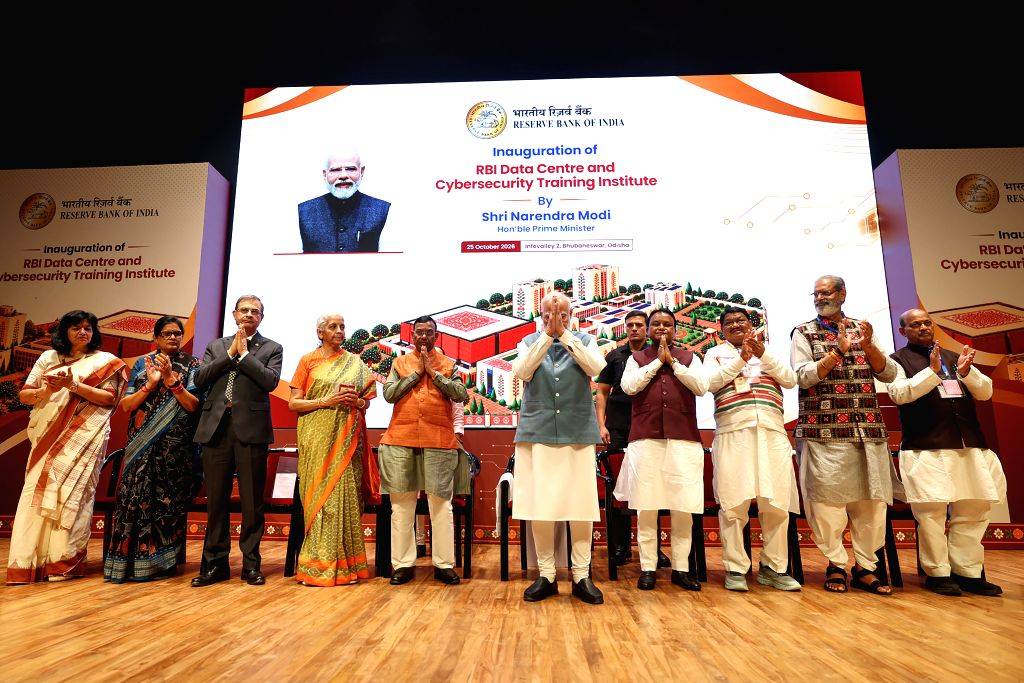
She spoke after Prime Minister Narendra Modi inaugurated the Reserve Bank of India’s (RBI) new Data Centre and Cybersecurity Training Institute in Odisha. The campus is meant to strengthen the sovereign infrastructure behind the country’s financial system.

Thirteen-thousand-fold growth in under a decade
The Finance Minister said UPI volumes have grown about 13,000 times since 2016-17. A system first used for small person-to-person transfers is now the default way to pay for groceries, utility bills, merchant purchases and much more, in cities and villages alike.

She said the growth is part of a wider push for financial inclusion. More than 59 crore people have entered formal banking through the Pradhan Mantri Jan Dhan Yojana, launched in 2014. These accounts carry no minimum balance and no annual charges. Direct benefit transfers through them have helped cut leakages in welfare payments.
On credit, she said the Pradhan Mantri MUDRA Yojana has sanctioned more than Rs 43 lakh crore across over 60 crore collateral-free loans to micro and small businesses. Women make up about 65 per cent of the beneficiaries. Under PM SVANidhi, around 1.2 crore loans have gone to street vendors. Many of these borrowers repaid their loans and then took larger ones to grow their businesses.

A “vault for the digital age”
The new RBI campus will host mission-critical payment systems, including Real Time Gross Settlement (RTGS) and National Electronic Funds Transfer (NEFT). Sitharaman called a data centre “the vault in the digital age”. She said secure, resilient infrastructure is now central to financial stability and long-term economic growth.
The Cybersecurity Training Institute on the campus has its own research wing. It is expected to build expertise in cybersecurity, artificial intelligence and data centre technologies across the regulated financial ecosystem.
RBI Governor Sanjay Malhotra repeated the central bank’s commitment to using emerging technologies, strengthening cyber defences and developing home-grown technology. This is a key point for the payments stack. The National Payments Corporation of India (NPCI) runs UPI as the retail switch, but final interbank settlement happens through the RBI’s own systems. The resilience of central bank infrastructure therefore supports every UPI payment.
Purvodaya and the data centre push
Sitharaman linked the Odisha campus to the Prime Minister’s Purvodaya vision for the development of eastern India. She also said the government gave data centres infrastructure status in 2022, and that the Union Budget 2026-27 announced a tax holiday for foreign companies that offer global cloud services from data centres in India.
What it means for the BFSI ecosystem
Banks, payment service providers, fintechs and merchants no longer need to prove that UPI can scale. The questions now are about resilience, settlement finality, fraud prevention and cyber readiness. Volumes are close to 80 crore payments a day, so even short outages or security incidents can affect millions of users.
Building sovereign, hardened infrastructure for RTGS and NEFT, along with a dedicated pipeline of cybersecurity talent, shows that regulators are planning for the next phase of India’s digital payments. In that phase, trust and uptime will matter as much as reach. UPI’s credit-on-UPI, insurance and investment use cases are opening formal finance to first-time users. The infrastructure behind it will decide how far, and how safely, that expansion can go.