

The UPI MDR delay has left India’s digital payment companies in a double bind. The merchant discount rate (MDR) on select UPI transactions still has no fresh start date, and fintech firms have not received government incentives for the past six quarters, according to an ETBFSI report published on 23 November 2026. The Payments Council of India (PCI), the industry body for digital payment companies, has raised both concerns with the government.
The squeeze comes as costs climb. Transaction volumes, compliance requirements and cybersecurity spending are all rising, while the two revenue sources the industry was counting on remain out of reach.

Why the UPI MDR delay matters for fintechs
The MDR framework was announced in September 2026 with a 15 October start date. It was then pushed to after Diwali to spare merchants extra costs during the festive season, and no new date has been set since. Earlier this month the market reacted, as the UPI transaction fee delay sent Paytm and Pine Labs shares lower.

Under the proposed rules, the charges are narrow by design:
- Person-to-merchant payments above ₹2,000: 0.4% MDR, capped at ₹300 for transactions of ₹75,000 and above.
- Railways, telecom, insurance, fuel and agricultural inputs: a flat ₹5 fee on payments above ₹2,000.
- Capital-market payments such as mutual funds and stockbrokers: 0.02% MDR, capped at ₹300.
- Exempt: payments below ₹2,000, small merchants under the zero-MDR framework, and person-to-person transfers.
That means only about 4% of merchant transactions would be charged, with about 96% unaffected. The Finance Ministry has said customers should not bear the fee, and banks have been told to make sure merchants do not pass it on. Business payments are also being reworked, with an expected flat ₹5 fee for merchant-to-merchant UPI payments.

Six quarters of unpaid incentives
The government raised the outlay for its digital payments incentive scheme to ₹2,196.21 crore in the FY26 revised estimates, up from a Budget estimate of ₹437 crore, and has set aside ₹2,000 crore for FY27. Yet industry sources say payment firms have not been paid for six quarters. Some companies have already booked the incentives in their accounts before receiving the money.
Record UPI growth raises the stakes
UPI keeps growing fast. It hit a record 25.47 billion transactions in October 2026, worth ₹31.53 lakh crore, with volumes up 23% and value up 16% year on year. That scale needs steady investment in infrastructure, merchant onboarding, customer service and fraud control, the same areas behind NPCI’s talks with Google to harden Android security against UPI fraud.
NPCI’s UPI Vyapaar Saksham scheme, which funds QR codes, soundboxes and usage incentives for small merchants in Tier 3 to Tier 6 centres, the North East, Jammu and Kashmir and Ladakh, is set to run for three years from the start of the MDR framework. A longer delay therefore also slows the push to bring more small-town merchants onto digital payments. Background on the framework is available from the National Payments Corporation of India, and the original report is on ETBFSI.
Key takeaways
- The UPI MDR framework, first due on 15 October 2026, still has no new start date.
- Payment firms say government incentives are six quarters overdue, and PCI has flagged both issues to the Centre.
- The proposed MDR would touch only about 4% of merchant transactions; small payments and P2P transfers stay free.
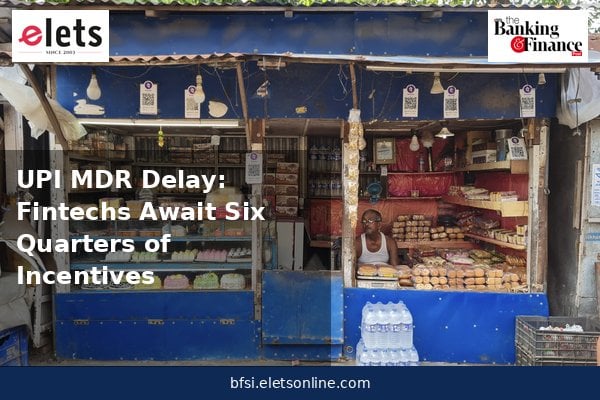
Featured image: A roadside shop in North 24 Parganas, West Bengal, with UPI QR codes displayed. Photo: Yooktashree Barai / Wikimedia Commons (CC BY-SA 4.0).