AI Forecast · BFSI
This is what AI says. It is an AI-assisted reading of publicly reported developments, reviewed by the Elets Editorial Desk. It is a qualitative assessment with stated uncertainty, not a probability or a prediction of certainty, and not investment, legal or policy advice. Outcomes may differ.
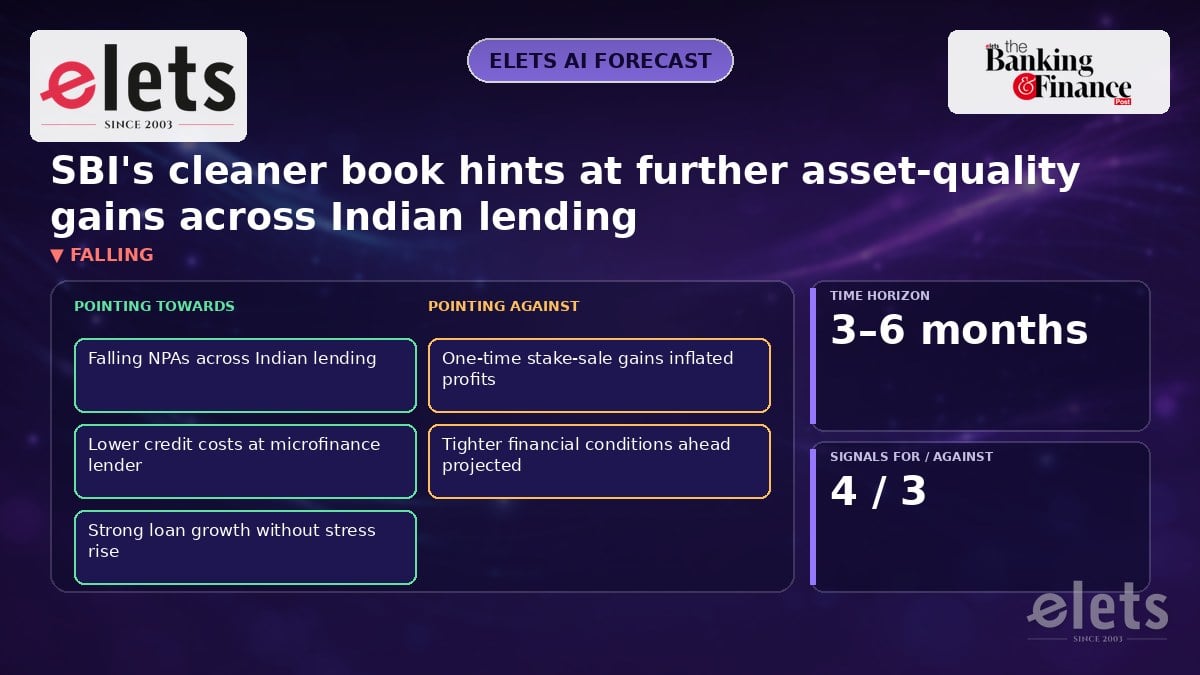
SBI's best asset quality in over two decades, echoed by lower credit costs at a microfinance lender, hints at a broader improvement in Indian loan books, though one-time gains and mixed macro signals urge caution.

Assessment: Gaining momentum · Horizon: 3–6 months · Direction: falling
Uncertainty: Part of SBI's profit improvement stemmed from a one-time stake-sale gain rather than purely structural loan-book recovery, and reports differ on whether results beat or missed estimates. Tighter fiscal and interest-rate conditions could test borrowers' repayment capacity and slow the trend.
Verified development
When: Q2 FY27
SBI reported Q2 FY27 standalone net profit of ₹23,038 crore, up approximately 14% year on year, with net interest income of roughly ₹49,142–49,143 crore. Asset quality reached a level not seen in over two decades, with non-performing loans declining and lower provisions contributing to the profit rise. Separately, a microfinance lender reported Q2 net profit of ₹86.48 crore and cited lower credit costs alongside microfinance growth, suggesting the asset-quality improvement extends beyond the country's largest lender.
Interpretation
Falling provisioning needs at SBI, combined with strong loan growth and no immediate rise in reported stress, suggest that headline NPA ratios across Indian lending could continue declining over the next three to six months if the credit cycle holds. The fact that a smaller microfinance lender also cited lower credit costs points to a broader, rather than bank-specific, improvement in borrower repayment behaviour.
However, the presence of a one-time gain in SBI's results, mixed readings on whether profit beat estimates, and one characterisation of asset quality as merely 'stable' rather than sharply better argue that the momentum may be softer than headline figures imply. A projected fiscal deficit above GDP targets and a higher floating-rate benchmark could incrementally raise borrowing costs, testing whether the cleaner loan books reflect durable improvement or a benign phase that tighter conditions could reverse.
Who it matters to
- Bank investors and analysts tracking NPA trends and provisioning cycles
- Credit officers and risk teams at public and private sector lenders assessing peer benchmarks
- Microfinance and NBFC operators watching whether sector-wide credit costs are falling
- Policymakers and regulators monitoring systemic loan-book health ahead of the next Financial Stability Report
Supporting signals
- SBI asset quality reached an over-20-year high with falling NPAs
- Lower provisions directly supported Q2 profit, indicating structural loan-book improvement
- A microfinance lender independently reported lower credit costs in the same quarter
- Loan growth remained strong without an immediate rise in reported stress
Contrary evidence and risks
- A one-time stake-sale gain inflated SBI's headline profit figure
- Reports are split on whether results beat or missed estimates, and one source characterised asset quality as only stable
- A projected fiscal deficit and a higher floating-rate benchmark point to potentially tighter financial conditions ahead
Next milestone to watch
- Q2 FY27 asset-quality disclosures from other public and private sector banks
- Microfinance and NBFC credit-cost trends reported in the following quarter
- RBI Financial Stability Report commentary on gross NPA trajectories
- Whether SBI's provisioning remains low in quarters without one-time gains
Editorial note
AI assisted the research and drafting of this forecast; the Elets Editorial Desk reviewed it and owns the published assessment. Reviewed: 04 Nov 2026. It gives a qualitative assessment, not a probability. Spotted an error or have an update? Write to the Elets Editorial Desk and we will correct it and note the change here.
This is what AI says. It is an AI-assisted reading of publicly reported developments, reviewed by the Elets Editorial Desk. It is a qualitative assessment with stated uncertainty, not a probability or a prediction of certainty, and not investment, legal or policy advice. Outcomes may differ.