AI Forecast · BFSI
This is what AI says. It is an AI-assisted reading of publicly reported developments, reviewed by the Elets Editorial Desk. It is a qualitative assessment with stated uncertainty, not a probability or a prediction of certainty, and not investment, legal or policy advice. Outcomes may differ.
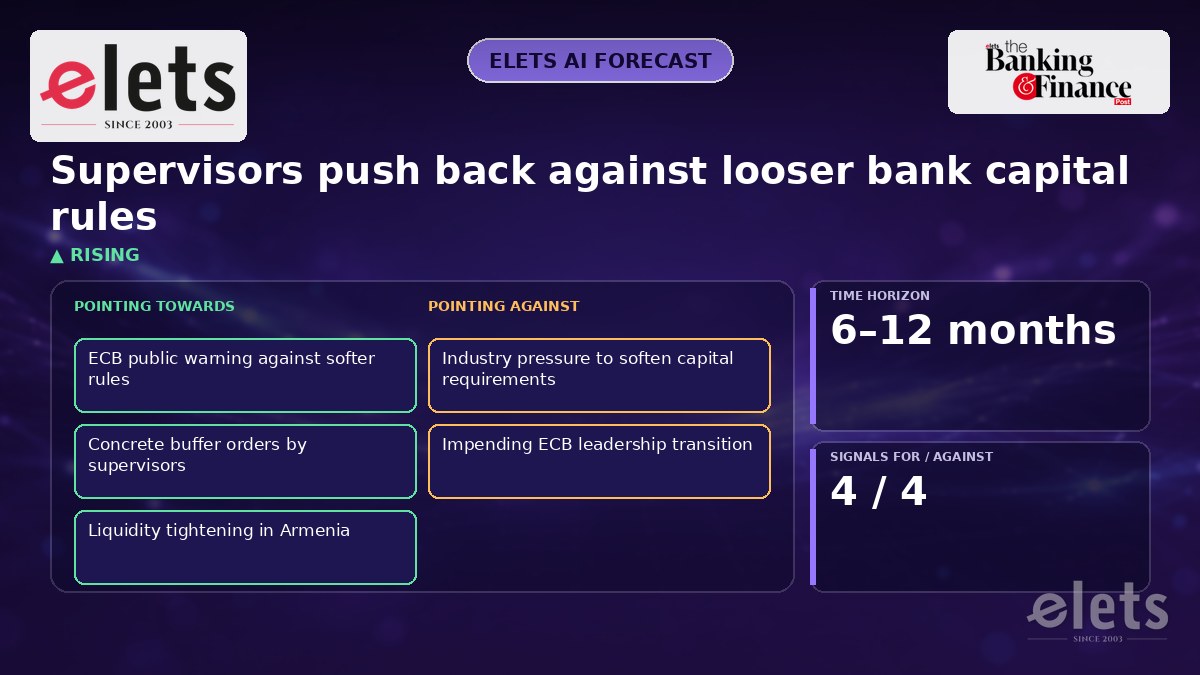
Concrete buffer orders, liquidity tightening in Armenia, and an ECB warning against looser rules signal a supervisory tilt toward prudence, though leadership changes and industry pressure could reverse the momentum.

Assessment: Gaining momentum · Horizon: 6–12 months · Direction: rising
Uncertainty: The outcome depends on whether ECB leadership after the upcoming presidential transition maintains the current hawkish stance on capital, and whether deregulatory pressure from parts of the financial industry succeeds in softening post-crisis rules across major jurisdictions.
Verified development
Across several jurisdictions, supervisors have taken concrete steps toward tighter financial requirements. The ECB issued a public warning against softening capital requirements for European banks. Separately, a central bank ordered lenders to hold an extra 1% capital buffer. The Central Bank of Armenia tightened liquidity requirements, citing the risk of large outflows, and raised its policy rate for the second consecutive time to 7%. Ghana's central bank flagged unlicensed mobile loan apps, and Nigeria renewed its call for local payment-data storage ahead of a January 2027 deadline, indicating that supervisory attention is broad.
Interpretation
These moves, spanning different jurisdictions and regulatory domains, point to a macroprudential posture oriented toward resilience rather than growth facilitation. If additional supervisors follow, lenders in affected markets could face higher capital costs and slower balance-sheet expansion, reinforcing a tightening cycle that extends beyond any single regulator.
At the same time, the ECB's warning implicitly acknowledges that industry pressure to loosen requirements is real and ongoing. A leadership transition at the ECB, with nominations due by a specified date, could shift the institution's emphasis, and moves by some regulators to ease access in parts of the financial system suggest the overall trend is not uniformly toward tightening.
Who it matters to
- European bank executives facing potential increases in capital costs
- Investors in bank equities, where higher buffers constrain returns and balance-sheet growth
- Policymakers and central bankers calibrating macroprudential tools
- Financial institutions in Armenia and other markets where liquidity rules have already tightened
Supporting signals
- The ECB issued a public warning against softer capital requirements
- A central bank ordered an additional 1% capital buffer
- Armenia tightened liquidity rules and raised its policy rate for the second consecutive time
- Supervisory activity is broad, covering mobile lending and payment-data storage in multiple markets
Contrary evidence and risks
- Evident industry pressure exists to soften European capital requirements
- An impending ECB leadership transition could shift institutional priorities on capital
- Some regulatory moves in other parts of the financial system lean toward easing rather than tightening
- Evidence covers only a handful of supervisors, limiting the basis for a global trend
Next milestone to watch
- ECB presidency nominations and the eventual appointee's public stance on capital adequacy
- Countercyclical capital buffer decisions by European and Asian supervisors
- Basel III implementation timelines in major jurisdictions
- Any central bank commentary on capital adequacy or additional buffer requirements
Editorial note
AI assisted the research and drafting of this forecast; the Elets Editorial Desk reviewed it and owns the published assessment. Reviewed: 04 Nov 2026. It gives a qualitative assessment, not a probability. Spotted an error or have an update? Write to the Elets Editorial Desk and we will correct it and note the change here.
This is what AI says. It is an AI-assisted reading of publicly reported developments, reviewed by the Elets Editorial Desk. It is a qualitative assessment with stated uncertainty, not a probability or a prediction of certainty, and not investment, legal or policy advice. Outcomes may differ.