


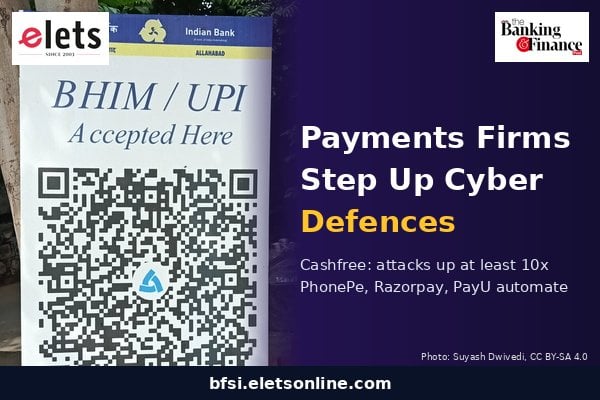


India’s leading digital payments firms, including PhonePe, Razorpay, Cashfree Payments and PayU, are stepping up their cyber defences, automating responses to attacks and tightening controls on money movement as AI-powered intrusions grow faster and more frequent, senior executives told The Economic Times in a report published on 2 November 2026.
The push follows a run of breaches across Indian financial services. ET reported that cyberattacks hit about 20 Indian financial institutions in October 2026, with stolen login credentials used to get around payment checks. The Reserve Bank of India has separately tightened cyber checks on banks and put fintech and NBFC APIs under scrutiny.

How Often Are Payments Firms Being Attacked?
Ramkumar Venkatesan, Chief Technology Officer, Cashfree Payments, told ET that the Bengaluru-based company has seen repeated attempted attacks over the past three weeks, at least 10 times as often as a year ago. He said attackers are increasingly chaining several vulnerabilities together to break into systems, rather than relying on a single weak point.

The pattern matches recent warnings for smaller lenders. Elets BFSI earlier reported that small NBFCs lost an estimated ₹300 crore to AI-powered cyberattacks as CERT-In flagged payment API exploits.
From Prevention to Detection and Containment
According to ET, the companies are shifting their focus from only keeping intruders out to spotting and containing a breach before customer data or funds are touched. Each firm described a different part of that playbook:

- PhonePe: scores the risk of each transaction within milliseconds and can hold suspicious settlements or reroute payments.
- Cashfree Payments: is shipping security fixes faster and isolating systems that may have been compromised.
- PayU: uses artificial intelligence for security analysis and compliance checks.
- Razorpay: has increased simulated attacks on its own systems and runs round-the-clock monitoring.
The common thread is automation. When attackers use AI tools to probe systems at machine speed, manual review alone cannot keep up, so payment firms are building controls that act on a suspicious transaction or system in real time.
Why Payments Cyber Defences Matter for UPI
The stakes are rising with volumes. The Unified Payments Interface processed a record 25.47 billion transactions worth ₹31.53 lakh crore in October 2026, according to the National Payments Corporation of India (NPCI), as festive spending pushed UPI to an all-time high. With Dhanteras and Diwali falling in November this year, the industry expects volumes to stay high, which widens the window for fraud and attacks.
Payment aggregators sit between merchants, banks and customers, so a single compromised credential or API can expose many businesses at once. Industry bodies are also building capacity; NPCI recently signed an MoU with IIIT Hyderabad to strengthen cybersecurity across digital payments.
Key Takeaways
- PhonePe, Razorpay, Cashfree Payments and PayU are automating cyber defences and tightening transaction controls, ET reported on 2 November 2026.
- Cashfree says attempted attacks are at least 10 times as frequent as a year ago.
- About 20 Indian financial institutions were hit by cyberattacks in October, per ET.
Frequently Asked Questions
Why are payments firms changing their cybersecurity approach?
Executives told ET that AI-powered attacks are faster and combine several weaknesses, so firms now focus on detecting and containing breaches quickly, not only on preventing them.
What can PhonePe do with a suspicious payment?
According to ET, PhonePe assesses transaction risk within milliseconds and can hold suspicious settlements or reroute payments.
How big is UPI now?
NPCI data shows UPI handled 25.47 billion transactions worth ₹31.53 lakh crore in October 2026, a monthly record.
Source: The Economic Times (ETtech), 2 November 2026; UPI data: NPCI UPI product statistics. Featured image: BHIM UPI QR code sign at Shaurya Smarak, Bhopal. Photo: Suyash Dwivedi via Wikimedia Commons (CC BY-SA 4.0).