

The National Payments Corporation of India (NPCI) on 5 November 2026 filed a Supreme Court affidavit defending the Unified Payments Interface (UPI) Merchant Discount Rate (MDR) framework challenged in a PIL by advocate Anjan Datta. NPCI said MDR hits about 4% of Person-to-Merchant (P2M) UPI transactions above ₹2,000 and called pass-through fears unfounded.
The plea challenges a 0.4% MDR on specified P2M UPI deals above ₹2,000. Reporting of the affidavit by Times Now says NPCI told the Court the petitioner failed to disclose material facts, including the 32nd and 34th reports of the Standing Committee on Finance and the deliberations recorded there, which were public before the framework issued.

What NPCI told the Supreme Court on UPI MDR
NPCI said a charge confined to roughly 4% of P2M deals above ₹2,000 leaves little scope for merchants to recalibrate prices across their full customer base for a fee that arises only occasionally above a defined value. It added that the small merchants and street vendors the petitioner fears will face an indirect burden are the class the framework is designed to shield.

Merchants receiving up to ₹1 lakh a month through UPI QR codes continue to enjoy zero MDR, NPCI said. A dedicated fund financed by a 5% contribution from MDR collections is meant to promote UPI adoption among small merchants with annual turnover of up to ₹20 lakh. NPCI argued that excluding small merchants from the charge and committing revenue to their digital inclusion cannot be read as working towards their exclusion.
Those points align with NPCI’s official MDR FAQ updated on 15 October 2026: UPI P2M deals up to ₹2,000 (more than 95% of volume) stay free of MDR, consumers are not charged, and Person-to-Person transfers remain free.

How the UPI MDR framework is structured
Elets Banking and Finance earlier reported that NPCI introduced 0.4% MDR on UPI transactions above ₹2,000. Published parameters include a ₹300 cap on deals of ₹75,000 and above, a flat ₹5 for selected industry categories above ₹2,000, and a separate 0.02% capital-market tier capped at ₹300.
NPCI’s FAQ records that the UPI and Services Steering Committee deferred go-live for the festive season, with implementation immediately post Diwali on a date to be notified separately (revised via press releases dated 13 October 2026). This article asserts no firmer live date than that official wording.
Why the Supreme Court fight matters for payments
On 28 September 2026 the Supreme Court refused to stay the Centre’s decision on UPI charges for individual-to-merchant deals above ₹2,000 and sought affidavits from the authorities. The petitioner argues the framework lacked adequate consultation, transparency or statutory safeguards and could indirectly burden citizens.
The dispute lands as UPI hit a record 25.47 billion transactions in October 2026 and as fintechs price MDR into margins. UPI MDR uncertainty has already shadowed India’s fintech IPO pipeline, while Paytm’s Q2 FY27 results flagged a margin lift from UPI MDR. Separately, NPCI formed tech subsidiary NTSL under Vishal Kanvaty, underscoring how infrastructure investment sits beside the MDR debate.
Key takeaways
- NPCI’s 5 November 2026 Supreme Court affidavit says MDR hits about 4% of P2M UPI transactions above ₹2,000 and calls pass-through fears unfounded.
- Small merchants with up to ₹1 lakh a month via UPI QR stay at zero MDR; 5% of MDR collections feed a small-merchant adoption fund (turnover up to ₹20 lakh).
- The Court refused a stay on 28 September 2026; go-live remains deferred to a post-Diwali date to be notified, per NPCI’s FAQ.
Frequently asked questions
Does UPI MDR charge consumers?
No. NPCI’s FAQ states consumers continue to use UPI free of cost; MDR is a merchant-side fee on selected P2M transactions above ₹2,000.
Which merchants stay at zero MDR?
Merchants receiving up to ₹1 lakh per month through UPI QR codes continue to enjoy zero MDR, according to the affidavit summary and NPCI’s FAQ.
When does the MDR framework take effect?
NPCI’s 15 October 2026 FAQ says implementation was deferred to immediately post Diwali at a date to be notified separately.
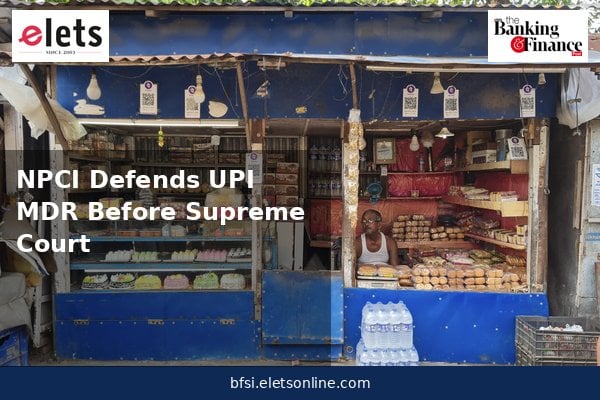
Featured image: Roadside sweet shop in North 24 Parganas, West Bengal, with PhonePe UPI QR stickers above the counter. Photo: Yooktashree Barai / Wikimedia Commons (CC BY-SA 4.0).