


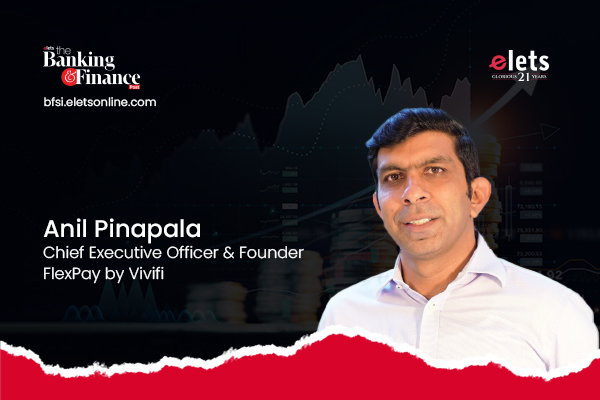


Providing unsecured credit in this predominantly secured lending market represents a significant shift, particularly for the lower end of this spectrum, and marks a transformative phase for Vivifi, shared Anil Pinapala, Chief Executive Officer & Founder of FlexPay by Vivifi in an exclusive interaction with Srajan Agarwal of Elets News Network (ENN).
The year 2023 has been transformative for many industries, including digital lending. Could you elaborate on the trends you’ve observed within this period? Specifically, can you discuss any notable achievements or milestones Vivifi has reached in terms of loan disbursements, customer acquisition, or other vital growth metrics?

Certainly. The 2023 fiscal year has marked a period of significant dynamism within our industry. Late in 2022, the RBI introduced digital lending guidelines, effectively streamlining the sector and guiding it towards greater transparency and accountability. As an industry, we’ve built upon this foundation, aiming to broaden the credit markets we serve and to extend credit access to customer segments previously unreachable through traditional financial avenues. Vivifi has seen a remarkable year, disbursing over 1500 crores to more than 5 lakh customers over the past 12 months—a notable milestone in our journey. Although this is just the beginning in addressing the needs of 300 million underserved individuals in India who lack credit access, we view it as a solid foundation. With recent successful funding rounds, both in debt and equity, we’re positioned to continue our growth and responsibly extend credit to many who currently lack access.
Following your recent achievement of securing Series B funding, could you share the strategic initiatives and key areas where these funds will be allocated to drive your organisation’s growth and innovation in the digital lending sector?
Until now, Vivifi has primarily catered to salaried individuals, the self-employed, and certain micro-entrepreneurs. Following our recent funding round, we aim to expand our involvement with the MSME sector. Our goal is to reach a broader range of micro-entrepreneurs, gig workers, and informal sector workers like street vendors, many of whom remain beyond the reach of conventional credit systems. The financial products required by these customers don’t align with standard models, especially given their daily or weekly income cycles, a common scenario among nano and micro-entrepreneurs as well as gig workers. Consequently, we are developing credit products specifically designed to accommodate these unique needs.

Our focus is on creating credit solutions that not only allow for flexible repayments but also depart from the traditional monthly installment model. Instead, we’re introducing options for equal weekly or daily installments, enabling customers to synchronise their repayments with their income patterns. This approach is a major emphasis for us as we venture into the MSME sector, a new but promising growth area. Providing unsecured credit in this predominantly secured lending market represents a significant shift, particularly for the lower end of this spectrum, and marks a transformative phase for our company.
How do you intend to prioritise the MSME sector in light of current trends and technological advancements? What strategies will you employ to support the MSME sector?
Indeed, the MSME sector has seen significant formalisation through various government initiatives, with UDYAM playing a pivotal role by providing unique identifiers to MSMEs lacking PAN cards. Other efforts are also contributing to formalising micro-entrepreneurs. Our aim is not only to extend credit to those already within the formal system but to also reach out to those currently outside it. We plan to integrate these consumers into the formal economy with the help of UDYAM assist. Our approach involves offering a range of products that don’t conform to the standard EMI model but instead provide flexible tenure and repayment schedules tailored to the unique needs of our clients.
The primary focus will be on secured products, particularly targeting loans under 5 lakh rupees to support small entrepreneurs and MSME businesses. This approach is designed to provide them with additional cash flow to navigate challenging periods or to invest in minor plant and machinery enhancements. Our goal is to adapt our offerings to better serve the evolving needs of the MSME sector.
Competitive advantages are pivotal in the fintech space. What distinct competitive edge does your organisation possess over other digital lending platforms in the market, and how has this advantage contributed to your company’s success?
Certainly, I consider competitive advantage to be more centered around the customer segment and customer-centricity. Our organisation is deeply customer-focused, placing ourselves in the shoes of our customers and prioritising consumer protection. Our emphasis lies in ensuring that customers comprehend the products and associated costs. By consistently prioritising customer interests and placing them at the core of our business, I believe this is our most significant competitive advantage.
Moreover, our focus extends to specific segments, such as salaried and self-employed individuals with incomes below 40,000 or 30,000 rupees. This demographic is often neglected by traditional banks and institutions. Similarly, we address the needs of MSMEs and nano-entrepreneurs with monthly turnovers below two lakh or one lakh rupees, who tend to be overlooked. Our commitment involves designing tailored solutions to facilitate their success in the credit journey. We perceive credit as an ongoing journey, aiming to help customers progress from a 20,000 rupees loan to larger financial milestones like vehicle loans or home loans, integrating them into the broader credit ecosystem.
When onboarding customers, our focus isn’t solely on immediate payments but on fostering a long-term relationship. We accept the responsibility of guiding customers into the formal financial landscape, nurturing their credit history to provide substantial access for enhancing their lifestyles and fulfilling aspirations for themselves and their families. This customer-centric focus forms the foundation of what I believe sets us apart competitively. Our perspective contrasts with viewing transactions as isolated events, as we genuinely believe in integrating customers into the formal institutional framework, shaping them into responsible borrowers throughout their lives, starting their journey with us.
Looking forward to 2024, what are the strategic priorities for your orgaisation, and how do you plan to implement these strategies to achieve your goals? Are there specific challenges you anticipate, and how are you preparing to address them?
In 2024, our primary focus will revolve around compliance. We aim to ensure responsible growth by implementing rigorous controls. As we expand and evolve into a larger Non-Banking Financial Company (NBFC), the regulatory expectations placed upon us will inevitably rise. Just as we prioritise customer-centricity, we are committed to transforming into a compliance-centric organisation. This shift is imperative in a regulated environment, where both aspects must align seamlessly.
We are currently executing various strategic initiatives aimed at enhancing compliance without compromising speed or hindering our overall growth. The development of new products is underway, accompanied by the creation of tools and technology sets to drive these endeavors. Our approach incorporates cutting-edge tools, including those powered by artificial intelligence and machine learning, particularly in customer service, all implemented with a keen sense of responsibility.
Also Read | Fintech Lenders vs. Traditional Banks: Bridging Financial Gaps and Driving Innovation
Considering the evolving landscape, the Data Protection and Privacy (DPDP) bill plays a pivotal role. As a digital-first or digitalonly business, integrating data protection and privacy measures is crucial. Therefore, for our industry and our organisation, maintaining a delicate balance between rapid growth and responsible practices is of paramount importance in the dynamic landscape of 2024.