




The Historical Perspective
The groundwork for automation in banking was laid way back in the year 1981. On the basis of the ‘First Rangarajan Committee’ report on Bank Computerisation in the year 1984, Banks started the use of MS DOS-based standalone computers at their branches.

Another committee was again constituted in 1988 under the chairmanship of Dr. C Rangarajan, the then Deputy Governor of RBI, to constitute a plan on automation of banks for a 5-year period. This paved the way to the implementation of multi-user Total Branch Automation or TBA packages running on a Local Area Network, either on a Netware or a UNIX operating system. With the implementation of TBA, Banks started to offer the facilities of an exclusive Customer Terminal, Single window transaction, online and off-site ATMs, Tele-Banking, etc.
Then came the new-generation private sector Banks, through 1994-96, whose modus operandi was to start offering anytime, anywhere Banking facilities to their customers. This was almost a paradigm shift moment for Indian Banking. For the first time perhaps, Banking in India was viewed & treated as a service, moving away from the more traditional approach of PSU Banks, who considered it as a specialised commodity. The new-age Private Banks advented Centralised Banking enabled through a Wide Area Network.
This technology, though, had a significant cost involved, in terms of IT, Infrastructure & connectivity, and the PSUs, with their much wider branch network & customer base, hesitated to implement CBS. But with the globalisation and liberalisation of the Indian market and with the enactment of TRAI during the late 90s, there was a signification reduction made possible in IT & infrastructure cost. Improved telecommunication facilities and a reduction in hardware as well as networking costs changed the mindsets of the behemoths of the Indian Banking space to try the CBS option. This also equipped them with the required technology leverage to compete in the Indian market by offering similar technology products and services, as those offered by their new generation competitors.

Core Banking System
CBS, most definitely, was the 1st major Solutioning that was witnessed by the Indian Banking Sector. CBS truly & effectively changed how Banks operated & served their customers in India. Made in India, much before it was actually turned into a slogan, the most widely used CBS software in India was developed by the Indian IT giants. Infosys Finacle and TCS BaNCS, along with Oracle FLEXCUBE, Temenos, and Mambu, are some of the major players in the CBS space in India today.
The Core Banking System in India is a comprehensive and integrated solution that streamlines various banking processes, enhances customer experience, and improves the overall efficiency of the banking sector. By addressing the needs of both banks and customers, CBS has played a crucial role in transforming the Indian banking landscape.
CBS is mandatory for all Commercial Banks in India, essentially meant clubbing of all the appended solutions and more, into a single platform
- Account management
- Deposit management
- Loan management
- Customer relationship management
- General ledger management
- Payment and settlement systems (NEFT/RTGS/IMPS)
- Risk management
- Regulatory Compliance Management
- ATM management
The Core Banking System revolutionised the Indian Banking sector by enhancing operational efficiency, improving security, offering better access for customers, and enabling cost-effective Banking operations. These advantages led to a more robust and customer-centric Banking in India. Some of the defining benefits of CBS are elucidated below:
| Advantages of CBS | Key Enablers |
| Efficiency of operations | Streamlined processes, centralised data, and resource optimisation |
| Enhanced security | Secure data storage, fraud prevention, and regulatory compliance |
| Better integration and access | Anywhere banking, multi-channel banking |
| Cost-effective operations | Reduced operational costs, scalability, and improved profitability |
The Digital Revolution
Over the course of the last decade or so, based on the then robust framework of CBS, Banking in India started the next chapter, namely, moving away from Conventional Banking to Convenience Banking. Boosted by 3G connectivity & enhanced access to the Internet, the Indian Banking Customer could finally move away from Banking at banks’ branches, defined by working hours, to Banking at their own convenient time & space. Network-enabled Point of Sale Terminals (EDC), Payment Gateways, Cash & Cheque deposit Machines, Recyclers, and International Fund Transfers through SWIFT were some of the new Solutions that Indian Banks activated for their customer base. Along with real-time fund settlement powered by RBI, these facilities were further fine-tuned by the Banking industry into the robust Solutions that are available for the Customers today.
For the Retail customers, Indian Banks are continuously augmenting their products & services; some of the Solutions worth mentioning, which could genuinely transform the Banking experience of the common man, are listed below:
- Tailor-made Savings Accounts with credit support & digital Banking tools, for the rural & unbanked segments
- Co-branded Digital Wallets & Credit cards for specific needs like Shopping, Travel, etc.
- UPI-enabled ATMs & deposit facilities
- Clubbed General & Life Insurance offerings on Accounts & Cards
- BNPL facilities on Online & Offline platforms
- Kisan Credit Cards
- Biometric Payment Authentication Services
- Unified Lending Interface
On the other hand, some of the major Solutions that are provisioned by Indian Banks for their Corporate customers are categorised & appended.
Payments
- Corporate Internet Banking: Tax Payments & Utility Bill Payments for all non-individual customers. Managing cash Flows, initiating payments, tracking transactions. Customised reporting for several needs, from account statements to historical balances
- BBPS: Integration with NPCI for integrated collections through Banking and NBFC channels. Offering unified, interoperable, and accessible bill payment services through a network of agents and online channels, enabling multiple payment modes, and providing instant confirmation.
- Host to Host Integrated payments: Single file upload for both cash and digital payments. Direct upload facility from the ERP system is available with H2H & API integration. Vendor and salary payments. Customised reports.
- Cash Delivery Services: Doorstep-banking and pick-up functionalities with one-time Beneficiary Registration
Collections
- Single Platform-based: Collections through multiple modes with validation and duplicate payment checks. Plug & Play Implementation with customised MIS reconciliation for all modes of Collection (card, net banking, UPI, wallets, ǪR, BNPL) with a single integration
- Virtual Account-based NEFT/RTGS/IMPS: Each client is provided with a 4-digit CORP CODE as an identifier with validation logic set as per requirement. Payment/Collection confirmation through H2H integration (server posting)
- Internet Payment Gateway: Multiple Collection Modes enabling ‘Customer not Present’ transactions, through cc/dc, net-banking, NEFT/RTGS, UPI/QR, SMS Pay, etc. Direct bulk upload option with Gateway customisation
- EDC/QR/SB/UPI: Digital Collections through Hardware using Master, VISA, Rupay & NPCI platforms
- Cash & Cheque: Secure and reliable pickup and delivery of cash and cheques from businesses, through multiple vendors & touchpoints, including Cash/Cheque Deposit machines & ATM recyclers. Handling of currency logistics, including sorting, processing, and transportation of cash, ensuring secure and efficient currency circulation.
Customized Solutions
- Treasury Collections & Payments: Banks acting as an Agency Banker for RBI & provisioning Government payments & collections. Daily reconciliation & reporting to the Department. & RBI e Kuber over SFTP. Daily remittance to RBI on a T+1 basis. Day-wise monthly statement (DMS) & other reporting. No credit against pending/ failed transactions.
- Escrow Management: Facilitating secure and transparent transactions, particularly those involving the conditional release of funds or assets. Reduce counterparty risk, increase transparency, and provide a secure method for managing funds during complex transactions.
- E-Tendering: Multiple mode collection through single integration, duplicate payment checks & validation. Automated refund to source as well as registered accounts. Email alerts to beneficiaries with refund details. End to End-to-end reconciliation reports
- ERP linked Beyond Banking: Solution specific beyond banking initiatives with partners and vendors for providing customised pitches basis ecosystem requirements. Integration of payment and collection solutions. Education, Medical, Hospitality, Religious, Municipal Tax Collections, RWA, Tourism, etc, are segments for ERP tagged Payment and Collection solutions.
The Way Ahead
These are but a bird’s eye-view into the huge Solution space that was & still is, Solution-enabled Banking in India today. Whilst these off the rack solutions have served and continue to serve the industry well, another major shift scheduled or maybe even already here is BaaS, Banking as a Service.
BaaS represents a semi-open Banking model that enables organisations outside the Banking sector to provide Banking services to their customers. This model is paving the way for new possibilities for companies, including Fintech startups and established players across various sectors, to deliver banking functions previously limited to traditional financial institutions.
Leveraging the established infrastructure and regulatory compliance of partnering Banks, accessing a range of Banking functions through Application Programming Interfaces i.e. APIs 3rd party service providers not possessing Banking License are integrating services such as account management, payment processing, and loan offerings to their customer base. BaaS has the potential to truly revolutionise the Indian financial landscape, providing great opportunities for enhancing financial inclusion, fostering innovation, empowering startups, and elevating customer experience.
- Enhanced Financial Inclusion: Through Microfinance/Lending, 0 balance Savings Accounts, Insurance penetration & more, BaaS can make Banking even more accessible, even in the small towns & villages of this vast country, with a substantial un-banked populace
- Innovation Stimulant: Tailored Products, BNPL schemes, and co-branded cards are to name a few of the products that can truly challenge conventional Banking
- Elevated Customer Experience: Having the capability to provide completely personalised services, through round-the-clock availability & interface interoperability.
Possible Challenges & Resolutions
The opportunities are huge, the horizon looks even brighter than before, but there are certain issues worth mentioning. Regulatory bodies have set stringent guidelines for financial services in India, aimed at protecting consumer interests and maintaining financial stability. However, the rapid evolution of Solutioning is often outpacing regulatory updates. As present-day Solutioning requires the exchange of sensitive financial data between multiple stakeholders, stringent privacy and data protection regulations have become the need of the day.
Cybersecurity Risks are a major concern for the Banking industry, and Banks must ensure to invest heavily in Cybersecurity Solutions to protect their customers’ data and prevent fraud. The entire BFSI industry needs to ensure robust encryption, secure data storage, and privacy-compliant operations to build user trust and comply with regulations. Some of the steps are worth considering.
- Weaving in alternate authentication mechanisms for digital payment transactions
- Broadening the scope, usage, and relevance of the Legal Entity Identifier in all payment activities
- Expanding interoperability to contactless transit card payments in offline mode
- Enhancing the scalability and resilience of payment systems
- Leveraging the Online Dispute Resolution system for real-time fraud monitoring and reporting
Innovation & Investment in infrastructure & Employee Knowledge Enhancement programmes by the Banking Industry, Digital Enablement, along with focus on Internet & Mobile Banking, combined with Automated Regulatory Compliance & Reporting, shall go a long way to face & address the risks involved.
Also Read: L&T Finance partners with Google Pay to simplify digital personal loans
The Financial Sector in India is standing at a precipice & Bandhan Bank is no exception. Utilising emerging technologies, partnering with the Fintech sector & adhering to Regulatory compliance is the way ahead for the Bank to continue in its remarkable journey of a couple of decades & scale even higher peaks. Utilising its scalable infrastructure & existing experience, the Bank aims to write a new chapter in the country’s financial landscape as it forays into making Banking more inclusive & more solution-centric in the days ahead.
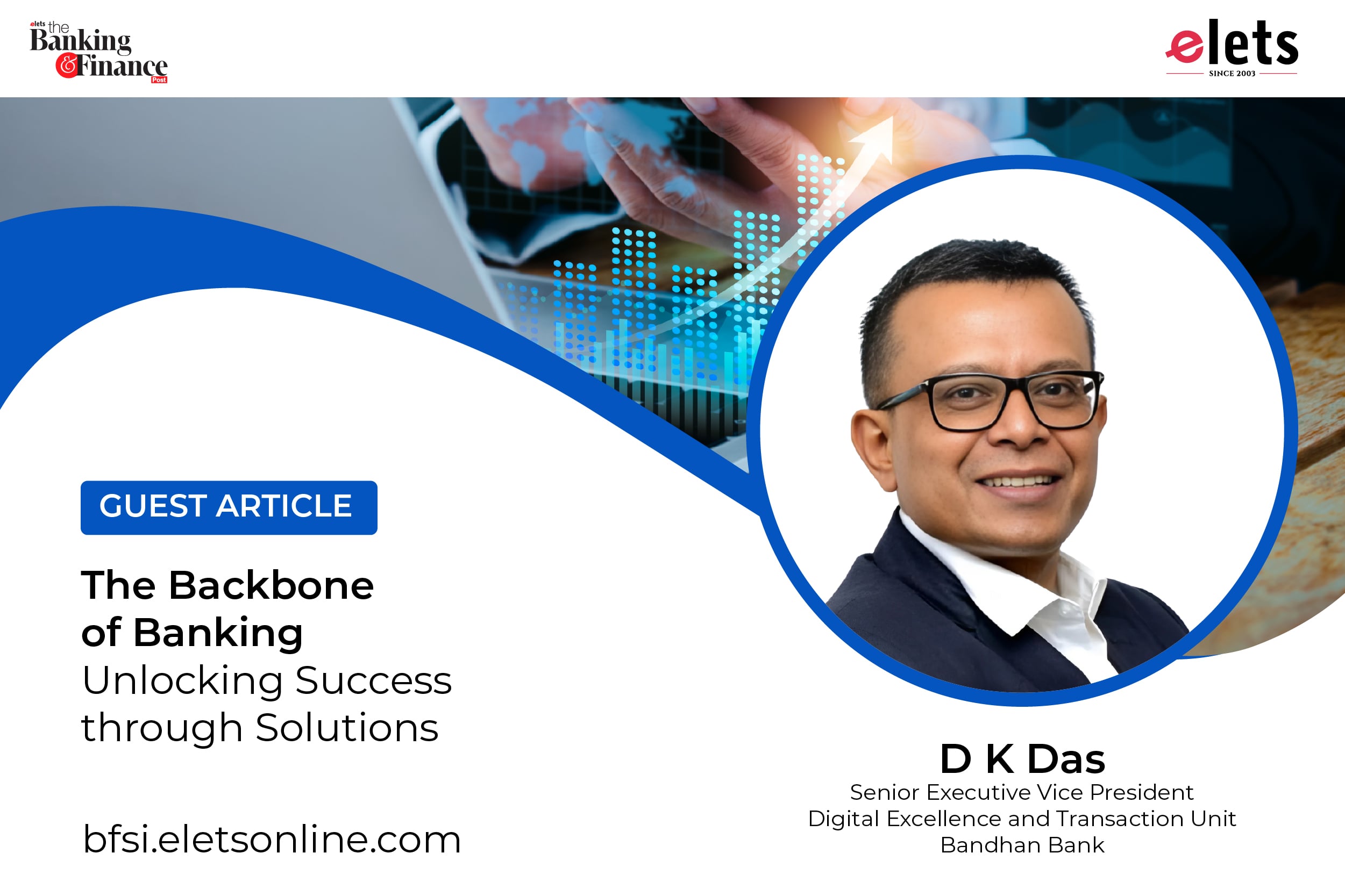
Views Expressed By: D K Das, Senior Executive Vice President, Digital Excellence and Transaction Unit, Bandhan Bank