


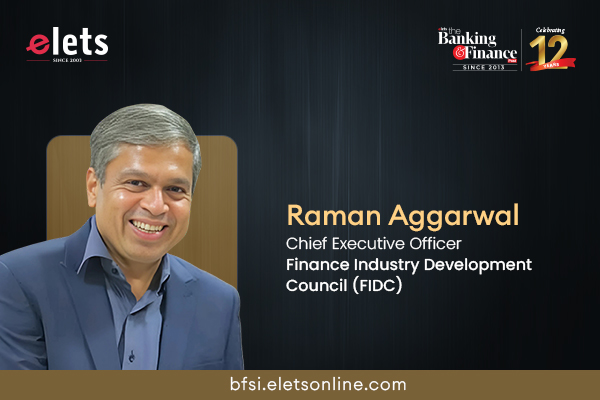


The NBFC sector is playing a pivotal role in India’s journey towards Viksit Bharat 2047 by deepening financial inclusion, empowering MSMEs, and bridging the last-mile credit gap across regions. With technology, partnerships, and progressive regulation reshaping the financial landscape, NBFCs are emerging as the real engines of inclusive growth. The Finance Industry Development Council (FIDC), as the representative body of asset and loan financing NBFCs, has been instrumental in driving policy advocacy and strengthening the sector’s voice. Raman Aggarwal, CEO, Finance Industry Development Council (FIDC), shares his insights on regulatory evolution, inclusion, partnerships, and the making of “SMART NBFCs” for a future-ready India, in an exclusive interaction with Vishwas Sinha of Elets News Network (ENN). Edited excerpts:
How do you view the regulatory and policy interventions shaping the NBFC sector today? Are they necessary to empower NBFCs for the vision of Viksit Bharat 2047?

No sector can progress or evolve without a proper regulatory mechanism in place. As long as that system is evolving, dynamic, and responsive to the sector’s needs, it is beneficial. On that count, I would give full credit to the Reserve Bank of India (RBI). In fact, at times I say RBI is even more proactive than the sector players themselves.
It’s heartening to see a regulator that is willing to evolve, engage in dialogue, and hold discussions with all stakeholders. This open and collaborative approach is what ensures a healthy ecosystem. I see this trend not only continuing but strengthening in the years ahead.
How can NBFCs better serve underpenetrated geographies such as eastern India or border states, where credit penetration remains low?

If you look at the history of the NBFC sector, NBFCs have always grown by serving the unserved and the underserved segments of society, the people whom nobody else caters to. I have always said NBFCs are the true drivers of financial inclusion.
I see no reason why NBFCs should not be lending in regions such as the border states or the northeastern part of India. Things are already changing. There are now many NBFCs emerging in eastern India, including those registered in Guwahati. The RBI’s regional office there caters to all the northeastern states. Many large, pan-India NBFCs are already operating across these regions.
To give a recent example, we received a query from the government about NBFC lending in Jammu and Kashmir. There was some apprehension of discrimination, but after collecting information from our members, we confirmed that was not the case at all. NBFCs view every geography as a new opportunity.
What is required is a facilitating environment, mechanisms for ensuring recovery, enforcing security or collateral, and policy support to manage local challenges. Certain areas face natural calamities or man-made risks, such as border disturbances. In such cases, government-backed credit guarantee schemes or risk-sharing programs can help.
The intent within the NBFC sector to serve these regions is 100% there. What we need is policy and environmental support to make it sustainable.
The government’s vision of Viksit Bharat 2047 has become a national call to action across sectors. From your perspective, how can NBFCs contribute to realizing this aspiration of an inclusive and developed India?
When we talk about Viksit Bharat, people often focus on creating flashy towns and urban infrastructure. But that’s not the true meaning. Development has to be inclusive. As our Hon’ble Prime Minister often says, real progress happens only when it reaches the last person, the bottom of the pyramid.
All growth must include every citizen, no matter where they live or work. That is the essence of true vikas or Viksit Bharat. And when it comes to inclusiveness, financial inclusion has always been the forte of NBFCs.
Even our Hon’ble Finance Minister recently said that NBFCs will be among the most important pillars of India’s growth, especially for last-mile credit delivery. Inclusion remains the key word, and NBFCs are central to achieving it.
How do you see NBFCs evolving over the next 20 years as India moves towards becoming a developed economy?
While the basic goal of NBFCs, catering to financial inclusion, will remain, the operations, modalities, and models will evolve. Two key words define the future: partnerships and technology.
NBFCs, banks, small finance banks, rural and cooperative banks – all have distinct strengths. The idea is to combine those strengths through innovative partnerships. A perfect example is the co-lending model introduced by RBI. Banks have liquidity; NBFCs have reach and collection capability. Together, they create a win-win situation for all stakeholders.
Going ahead, technology will further expand the scope of such partnerships, not just in number but also in their structure and nature. The ecosystem will become more collaborative, tech-enabled, and dynamic.
If you were to define the future-ready NBFC in one word, what would it be?
If I have to define it in one word, I would say: SMART.
Just like smart cities, we now need smart NBFCs. But a smart NBFC doesn’t mean it should be purely technology-driven. Technology is an important part, yes, but not the whole. When you reach out to the last mile, the human touch still matters immensely. Lending cannot happen without the human element.
So when I say smart, I mean three things:
- Tech-enabled: Use technology effectively but balance it with empathy and human connection.
- Agile: Be aware and ready to evolve quickly. Gone are the days of static business models. Something new comes up, and you must adapt swiftly.
- Engaged: Don’t just comply with regulations; proactively engage with regulators and policymakers. Become their eyes and ears — report ground realities, evolving challenges, and potential risks.
Regulation doesn’t appear overnight. It evolves from what happens on the ground. The more agile you are in updating policymakers, the more responsive regulation will be.
The government and regulators are open today, so why shouldn’t we be? Being smart means being proactive, innovative, and participative.
What message would you like to give to new NBFC players and entrepreneurs in this space?
Don’t think of yourself as “small.” That mindset has to change. In fact, in our work at FIDC, 80% of our time and effort goes toward addressing the issues of smaller players.
Even the government and ministries today are focused on MSMEs – the smaller segment. The spotlight is on you. Being small is not a disadvantage; it’s an opportunity.
Of course, smaller players sometimes face compliance challenges or operational constraints. But even then, it’s important to be transparent and report those issues proactively to the regulator, rather than waiting for action to be taken.
So yes, being small is actually beautiful. The focus of the ecosystem is on you, and you have every opportunity to grow, contribute, and shape the sector’s future.
I would just say, don’t be passive recipients of change. Be smart, be proactive, use technology, innovate, and engage constructively with policymakers.
The NBFC sector has always been at the forefront of financial inclusion. If we stay smart, inclusive, and adaptive, we will continue to be the true engines of India’s financial transformation.