



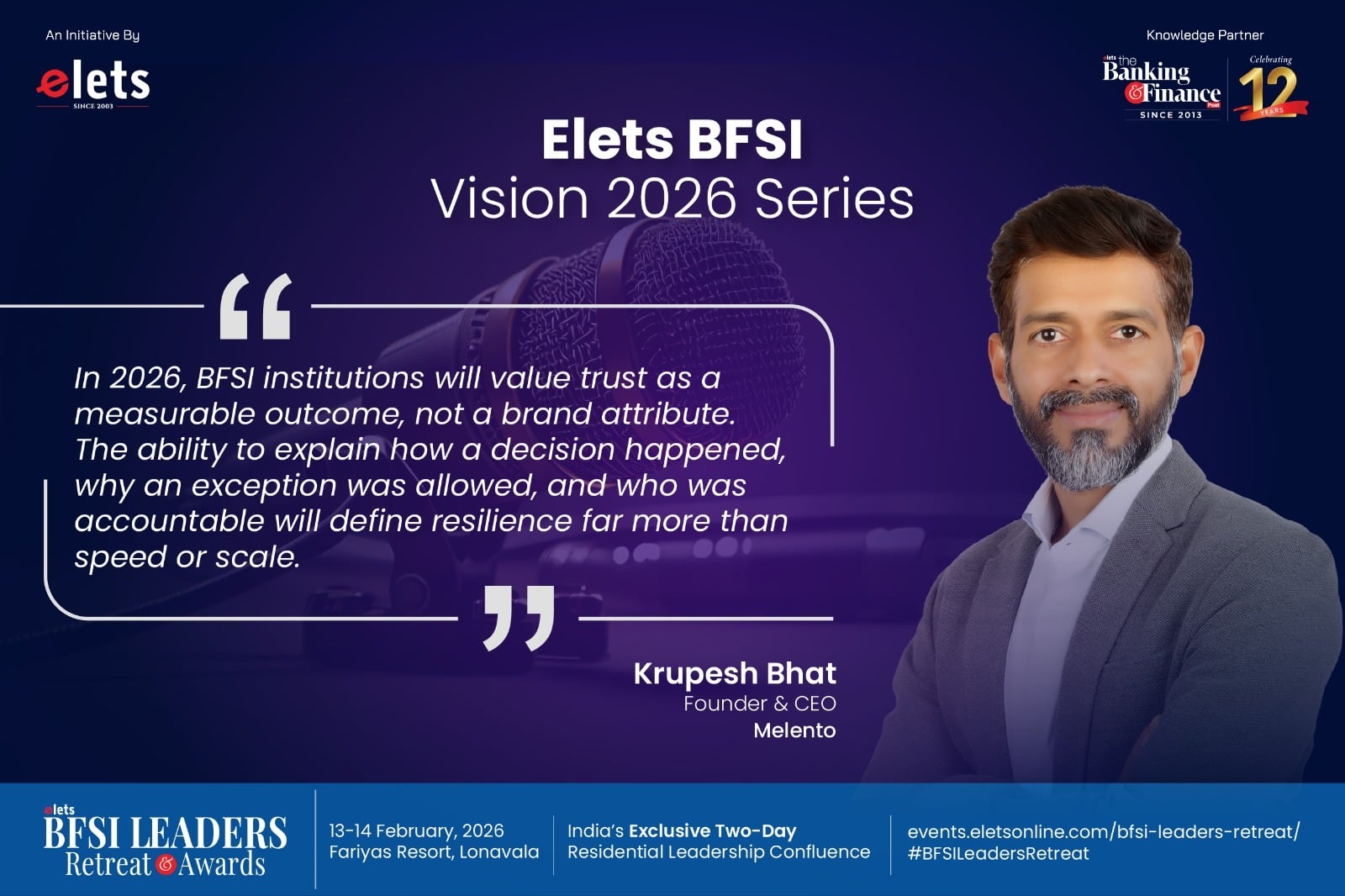


Institutions are entering a phase where digital processes alone are no longer enough; the ability to trust, explain, and defend decisions is becoming central to scale and compliance. Melento is addressing this shift by embedding collaborative intelligence into approval-driven workflows, enabling clear accountability and traceability across operations. In an exclusive interaction for the Elets BFSI Vision 2026 Series, curated by Elets Technomedia, Krupesh Bhat, Founder & CEO, Melento, shares why decision accountability will define resilience and regulatory confidence in the years ahead.
As we look toward 2026, how is your organization aligning its solution roadmap with the evolving priorities of BFSI leaders?

As we look toward 2026, BFSI leaders are navigating an uneven reality. While the user journey of onboarding to underwriting to contracting has been digitised, decision-making within those processes remains fragmented and heavily human-dependent. According to the PwC BFSI risk study, over 55% of operational and compliance issues arise not from system failure, but from how decisions are made, handed off, or approved. Melento’s roadmap is aligned to address this gap. We are investing in what we call “collaborative intelligence” not as a buzzword, but as a design principle. The focus is on systems where human judgment and intelligent automation work together, with clear accountability, traceability, and context preserved at every step. In 2026, BFSI leaders won’t be asking whether a process is digital. They will ask whether decisions made within that process can be trusted, explained, and defended. Our roadmap is built for that shift.
Which outcomes will BFSI institutions value most by 2026: trust, resilience, efficiency, compliance, or customer experience, and how are you enabling that shift?

In 2026, BFSI institutions will value trust as a measurable outcome, not a brand attribute. Efficiency and customer experience will remain important, but recent events show their limits. A McKinsey study found that over 70% of major operational failures in financial institutions stemmed from process breakdowns rather than technology outages. That’s why resilience and compliance are rising to the top. At Melento, we see institutions prioritising the ability to prove decisions, not just execute them. This means systems that can explain how an approval happened, why an exception was allowed, and whether authority was valid at the time. When these elements are embedded into workflows, efficiency and customer experience improve naturally because rework, disputes, and escalations are reduced. In 2026, the winning institutions will be those that design for trust first and let speed follow.

Across banking, NBFCs, and fintech, where do you see the most urgent technology gaps emerging over the next two years?

The most urgent technology gap across banks, NBFCs, and fintechs is decision accountability across fragmented workflows. While core systems have modernised, approvals still live across emails, spreadsheets, and disconnected tools. World Commerce & Contracting estimates that nearly 50% of contract and onboarding delays in financial services are caused by approval ambiguity rather than system downtime. Another growing gap is clarity around human versus system responsibility as AI-driven processes increase. Regulators are already asking not just what decision was made, but how it was made and who remains accountable. Most systems today are not designed to answer that cleanly. At Melento, we see this as the next frontier: making decisions traceable without slowing execution. Institutions that close this gap will scale with confidence. Those that don’t will discover these weaknesses under regulatory or audit pressure.
Also Read: Vision 2026: The Next Phase of Intelligent BFSI Infrastructure
How do you see the role of technology partners evolving, from solution providers to strategic collaborators, in the BFSI ecosystem?
Technology partners in BFSI are moving from feature vendors to long-term risk partners. In 2026, institutions will expect vendors to understand regulatory context, operational nuance, and failure modes- not just product requirements. Gartner estimates that by 2027, over 40% of BFSI technology contracts will include shared accountability clauses tied to compliance and audit outcomes. This changes the nature of the partnership entirely. At Melento, we see our role as helping institutions design systems that balance speed with defensibility. That means co-creating workflows, pressure-testing them against audit scenarios, and evolving them as regulations change. The future partner will not simply deploy software and step away. They will stay engaged in how decisions are executed and reviewed. BFSI institutions are consolidating vendors because managing multiple providers has made it difficult to address security, compliance, and data privacy requirements effectively.