


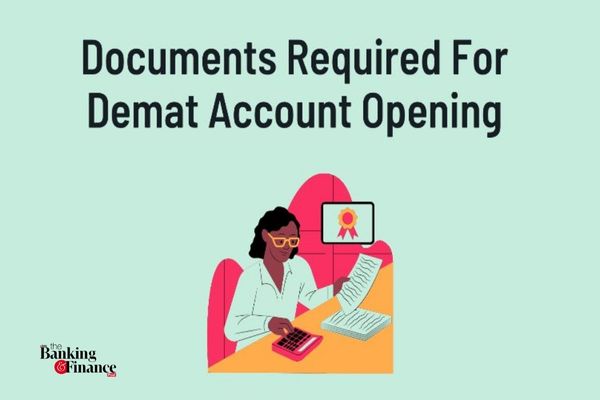


Led by significant stock market returns and an easy investing process, more and more retail participants are getting interested in stock market investments and are opening online demat accounts. Numerous millennials are joining the bandwagon.
The SEBI (Securities and Exchange Board of India) keeps an eye on stockbrokers if the trading activities are practised as per the compliance regulations.

KYC (Know Your Customer) compliance is one of its requirements. Digitisation of the KYC is one of the foundations of an effective Anti-Money Laundering process. Every SEBI-registered stockbroker must collect identity and address proof from investors.
The Importance of KYC Compliance
KYC compliance is necessary as it helps the regulators to provide security to demat accounts. KYC compliance is mandatory. KYC involves documenting all the relevant records to authenticate the investor’s identity, funding sources, and citizenship.
KYC Documentation for Demat Account Opening

Investors need to fulfil KYC requirements as per norms of the SEBI to open a demat account. According to the SEBI, investors need to submit KYC documents required for demat account for six attributes to complete KYC compliance which may change over time. Therefore, investors must keep the KYC information updated with the broker. KYC attributes that investors need to comply with are as follows:
– Name
– Address
– Income
– Permanent Account Number (PAN)
– Active Mobile Number
– Active Email ID
The documents required for KYC formalities are as follows:
● Identity Proof – PAN card/Aadhaar card/Passport/Driving License/other ID card issued by the Indian Government
● Address Proof – Passport/Voter ID/Ration card/Utility Bill/Lease Agreement/Insurance/Bank Statement/ID cards issued by the Indian Government with mentioned address
Stockbrokers leverage technology and make KYC compliance easy. Under Section 11A of the Prevention of Money Laundering Act, 2002, the SEBI allows e-KYC authentication using the Aadhaar number in the stock market for Indian investors.
e-KYC Charges
Stockbrokers leverage technology and make KYC compliance easy. Under Section 11A of the Prevention of Money Laundering Act, 2002, the SEBI allows e-KYC authentication using the Aadhaar number in the stock market for Indian investors.
When individuals sign up for a demat account with a stockbroker, they need to fill up a demat account application form and e-KYC form. Generally, discount brokers offer a free demat account and do not charge for KYC processing.
However, for Aadhaar authentication services, the Unique Identification Authority of India (UIDAI) can charge a negligible amount from private entities. Requesting entities (Brokers) may need to pay Rs. 20 for each e-KYC transaction and Rs. 0.50 for authentication of transaction.
e-KYC for Quick Demat Account Opening Processing
Stockbrokers leveraging new-age technologies allow investors to open a demat account following a 100% digital account opening process. It involves in-person verification (IPV) for KYC formalities with a video call or recorded short video. Here are the steps to follow at the official website of the broker:
● Refer to the broker’s official website and hit the ‘Open Demat Account’ button to access the demat account opening application form.
● Fill in the application form with basic personal details, like, name, age, city, an active email ID and an Aadhaar-linked mobile number to initiate the demat account opening process.
● Scan the copies of the required documents for KYC as mentioned above. Upload them while completing the account opening form.
● E-sign the form using the OTP (one-time password) received on the registered Aadhaar-linked mobile number.
● The applicant must record a short video of 30 seconds for the IPV (In-Person Verification) and Upload it.
● Submit the application form accompanied by KYC documents for review.
● The broker will review the details and activate the account after successful verification.
Get an activated demat account online. Log in to the demat account and start investing without any worries.
Key Advantages of New-age KYC
● Safety with Regulatory Compliance: Digital KYC helps investors and brokers to meet their regulatory responsibilities and ensure safety, quality, and efficiency in the framework.
● Free of Cost Processing: Digital KYC processing does not involve a charge from customers. The broker may need to bear the automation costs of installing validation systems.
● Extremely Quick Real-time Processing: eKYC is fully automated. The process is completed in real-time without much hassle. Compared to paper-based KYC, digital authentication takes much less time, only a few minutes.
● Convenient: There is no need to visit the broker’s branch to submit papers and complete KYC formalities. e-KYC is substantially convenient.
● Usage Transparency: All records are saved in a centralised system that can be accessed by authorities only. There is no risk of lost data or illegitimate use of papers.
Thus, the KYC process is mandatory to invest in the securities market following the SEBI guidelines. KYC compliance makes trading transactions safer and reduces stances of fraudulent and illegal monetary activities. Just submit basic documents for KYC verification – identity proof, address proof, PAN, and bank account details to open a Demat account within a few minutes following a digital process.
Investments in securities market are subject to market risk, read all the related documents carefully before investing.