


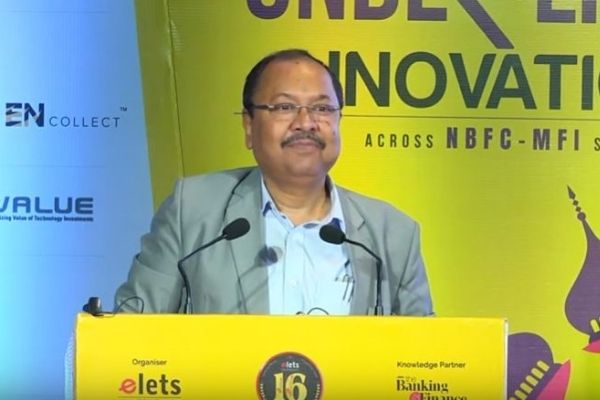


The Pradhan Mantri Jan-Dhan Yojana is a landmark achievement of the government, but the challenge is to keep those accounts operational, observes Subrata Gupta, Chief General Manager, NABARD, in an interaction with Kartik Sharma of Elets News Network (ENN)
The Government in India has given a push to financial inclusion drive. Do you think we have enough infrastructure to support the programme?

Pradhan Mantri Jan-Dhan Yojana (PMJDY), initiated by the NDA Government, has moved things to the next level. It doesn’t mean that the previous governments did not make any efforts towards it. However, the banking sector has certainly evolved over the last few months with the opening of more than 11 crore accounts under PMJDY.
But somehow, not much financial transaction is happening in these accounts, so there is a need to modify to keep the accounts active. Through Direct Benefit Transfer (DBT), at least once in 45 days, these accounts should be kept operational.
If the accounts are active, we will not have enough financial outlets to serve all the accounts. Although the programme started by Prime Minister Narendra Modi with a noble intention, insufficient number of ATMs and micro-ATMs to cater to such a huge population is another important issue. It can only be resolved by setting up new ATMs, micro ATMs, and commercial banks.

As PMJDY has received overwhelming support, with the states also participating enthusiastically in the initiative, what do you think is the next step in this direction?
DBT is the next step. The accounts are going to be Aadhaar-linked. Once the accounts are Aadhaar-linked, the DBT will start flowing into these accounts. As most of the people are below the poverty line, they require some subsidy in the form of cash transfers. So, some money needs to be transferred into those accounts. By the way, the LPG subsidy has started reaching directly into these accounts since 16th January.
Another advantage of PMJDY is overdraft facility up to Rs5,000. After observing the banking behaviour of a person, he can be provided the money, and if he returns the money on time, his banking credentials can increase and become eligible for higher loans. With good credit history, banks would have better opportunities to do business with those account holders.
The urban population is familiar with the bank services, but how will you make rural population financially literate?
Financial literacy is a big challenge in India, but not as big as it appears to be. Even in rural India, people save money in traditional manner and that saved money is utilised in times of need.
To avail the insurance benefits, it is advisable to those cwho have opened accounts under PMJDY to do transaction once in 45 days. One lakh cadres are to be trained through CSC (Common Services Centres). With the surge observed in the number of accounts, the need for financial literacy is being acutely felt.
What is the role for co-operative banks in PMJDY?
Co-operative banks are not restricted from issuing the cards. They are participating in the financial inclusion drive, though their visibility is low.
Self Help Groups (SHGs) also come under the purview of PMGDY?
SHGs are different from PMJDY. The motive of SHG movement was completely different from PMJDY. They have the goal of empowering the people at the grass root level. SHG enable them to access the financial services at any point of time at lesser costs of operation and self help. PMJDY is more of a technology-oriented entity, where there are cards, micro-ATMs, servers and other technologies involved. It is more of an individualistic approach. SHGs do not stop the members from opening individual accounts. An SHG member can operate on both individual as well as group accounts, simultaneously.
With reference to the role of co-operative organisations in PMJDY, there is still lot of awareness yet to be raised. What is your opinion?
Yes, the transactions of co-operative bodies are going to be digitised very soon. Once banks are able to do e-tracking of the SHG transactions, it will become accessible to every branch manger. Then they would know who is doing what. And, once SHG accounts are linked with Aadhaar, it would be easier for others to know the activities of an SHG member.
Financial literacy is a big challenge in India, but not as big as it appears to be. Even in rural India, people save money in traditional manner and that saved money is utilised in times of need
PM Modi has advocated in favour of cashless society. What do you think about it and what are its challenges?
I will be very happy if this happens. However, the tendency towards hoarding black money is one big challenge. Apart from that, having touch points at every place and spot is also an important issue.
How do you visualise the situation when schemes like PMJDY will be truly realised and be in full flow?
After opening of the account, other issues like issuance of cards on time, etc., will have to be fixed. It will take one-to-two years when all the accounts opened under the scheme will be settled and will start proper banking activities.